Laboratory products
Published over 16 years ago. See the latest and most current information on Laboratory products.
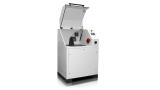
With the analytical sieve shaker AS 450 Retsch have designed their first siever for 400mm and 450mm sieves, which operates with a three-dimensional sieving motion. It can be used for dry and wet sieving. The optimised electromagnetic drive allows for an amplitude up to 2.2mm which renders the separation process much more effective than with other sieve shakers of this type.
Reproducibility plays an important role: the amplitude - which is independent of the sieve load - is continually adjusted. The three-dimensional sieving motion lets the sample material move equally over the complete sieving surface. This results in high load capacity, extremely smooth operation and short sieving times with high separation efficiency. When it comes to operating comfort, the AS 450 meets all the requirements of a modern laboratory. All parameters such as amplitude, time and interval are digitally set, displayed and controlled. It is possible to store up to 9 parameter combinations for routine tasks.
Benefits include: suitable for dry and wet sieving; measurement range 25 μm to 125mm; high sieve loads (up to 20kg); excellent separation efficiency even with short sieving times; digital parameter setting with controlled amplitude; and mobile operation panel for comfortable handling.
ILM Guide 2026/27

 Product directory