Microscopy & microtechniques
Published over 14 years ago. See the latest and most current information on Microscopy & microtechniques.
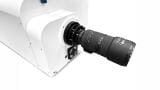
The FLIR SC7000 Series of Infrared Cameras from FLIR Advanced Thermal Solutions (ATS) provide the high performance and facilities for thermal imaging of high speed events. These high-speed, highresolution research grade cameras provide Gigabit Ethernet, Camera Link and USB interfaces for maximum flexibility and performance. They also feature simultaneous digital and analogue outputs, and are available in multiple wavebands, detector resolutions, and lens configurations. Their fast frame rates, plus adjustable and triggered integration times, allow you to capture fast moving objects and those with rapidly changing temperatures. High-speed IR thermography can reveal hidden features of fast-moving objects when their temperature is higher than the background. The video and data acquisition capabilities of FLIR's advanced IR cameras allow the capture of thermal images at rates exceeding 62,000 frames per second. This is equivalent to an exposure time of a few microseconds. Thus, individual video frames can provide still images of a fast moving target or thermal event, referred to as stop-motion imaging. Applications include thermal and dynamic analysis of jet engine turbine blades, supersonic projectiles, and explosions.
Whether the application calls for stop-motion or a video sequence, high-speed IR cameras can supply images of fast-moving objects with minimal blur. FLIR's advanced camera systems make this possible with analogue-to-digital (A/D) converters that provide high resolution and short integration times. The shorter the integration time, the less likely there will be blurring. When data acquisition is fast enough, it's possible to capture a sequence and play it back in slow motion. Avoiding image blur is also tied to the superior thermal sensitivity of FLIR camera detectors. With more sensitive detectors, the data integration time can be shorter, because less energy (IR radiation) is required to record an acceptable image. This is particularly important when you need to image fast-moving, low-energy targets. So, the higher the camera's sensitivity and frame rate, the better the results.
ILM Guide 2026/27


 Product directory