Laboratory products
Published over 17 years ago. See the latest and most current information on Laboratory products.
Shortly after the market launch of Anton Paar’s DMA Generation M density meters, Analytik-Service Gesellschaft (ASG), the leading service
provider in the field of fuel analysis, purchased a DMA 4500 M with a sample changer Xsample 452. How does the DMA 4500 M perform in
comparison to the previous models DMA 48 and DMA 4500 and what were the decisive factors for the decision to purchase the new instrument?
ASG was the first ever pan-European accredited testing institute for the analysis of fuels made from biogenic raw materials. It was established
in 1992 on behalf of the fuel trade, government committees, the automobile industry and other associations. The headquarters of ASG is
in Neusäß, near Augsburg, Germany. Further offices in Australia and Brazil successfully put German know-how into practice abroad.
Besides the routine analysis of biogenic and fossil fuels, ASG engineers are particularly proud of the method they developed to detect
steryl-glycosides using thin-layer chromatography. ASG also has an established reputation for the production of reference oils.
Since the end of 2007 ASG has been advising manufacturers of biofuels on how to optimise their production process. These consultations
take place in ASG’s own technical centre with its wide range of equipment and measuring instruments, which are used to optimise
chemical reactions in oil or test new recipes. Other issues are the selection of feedstocks and finding energy-conserving reaction conditions
to produce fuels which conform to specific norms. How much catalyst is required? Which reaction conditions are needed to ensure
complete transesterification? The answers to these questions and more can be found using ASG’s well-equipped laboratory and
implementing their knowledge collected throughout 15 years in the field.
Determining the Density at ASG
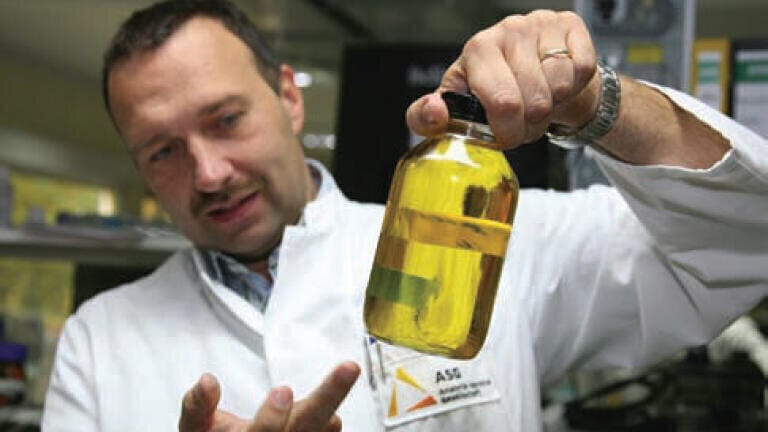
The first step in every analysis at ASG is the determination of density. Density determination is simple, quick and inexpensive, and provides
a sum parameter which is ideal for plausibility checks on samples. Is the sample diesel, petrol or rapeseed oil? Is the product description
consistent with the provided sample? The samples which are analysed are oils and biogenic fuels with a viscosity of 3 to 50 mPa.s which
come from oil mills, biodiesel manufacturers and trading companies.
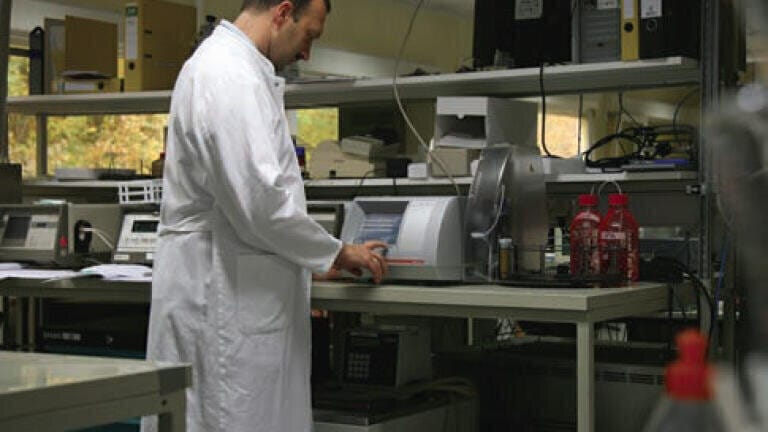
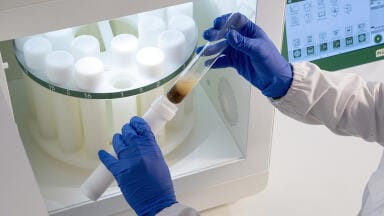
Shortly after the laboratory opens for the day, the new sample changer is filled with samples. Each sample is quickly identified with a bar
code reader. There is space for up to 48 samples and each sample can be assigned its own method and measuring temperature. And that
is all that needs to be done: measurement, cleaning, verification and data processing are all performed by the DMA 4500 M. Any
measurement errors are detected automatically.
The New DMA M
When developing DMA Generation M the focus was on making the measurements and results as reliable as possible. A cautious further
development of the existing DMA series was not enough – Anton Paar’s aims were much more ambitious. In particular, three new technical
highlights now lead the way to reliable results: FillingCheckTM, U-ViewTM and ThermoBalanceTM.
FillingCheck™
Anton Paar and the inventor of the digital density meter, Dr. Stabinger, developed FillingCheckTM to prevent the results being influenced by any
gas bubbles filled with the sample. FillingCheckTM uses a measurement to detect filling errors and gas bubbles, and alerts the operator with a
warning in the results list. Combined with a sample changer, the new Generation M density meter is a very economical system for ASG. DMA
4500 M instruments can be left to work unattended during the day and when the workload is large, samples can be measured at night.
U-View™
Besides providing error detection based on a measurement, Anton Paar also wanted to offer an optical check of the whole measuring cell.
To meet this requirement, Anton Paar engineers, in cooperation with Dr. Stabinger, developed U-ViewTM. U-ViewTM shows live images of
the U-tube on the display with the whole filled-in sample clearly visible. If required, an image of the filled U-tube can be stored as a data
file attached to the measurement protocol along with the results. For ASG this means the results can be verified at a later date should
there be a query.
ThermoBalance™
The prerequisite for exact density measurement is precise temperature control and adjustment. ThermoBalanceTM makes extremely short
thermostatting times possible – and allows measurements at different temperatures with only one density adjustment. In practice this means
rapid throughput and just one density adjustment required, even when the measuring temperatures vary greatly, as is often the case at ASG.
This comes from having to follow a number of different norms, and also in order to fill highly viscous samples into the measuring cell.
Summary: Anton Paar’s new DMA 4500 M
According to the head of the laboratory, Dr. Tröster, the new DMA 4500 M sets new standards in automation and reliability of the results: “If
we view the capabilities of the new generation of Anton Paar density meters and our current developments in the laboratory, we are more
than sure that we made the right choice.“
ILM 51.6 Sept 2026


 Product directory














.jpg)
.jpg)
.jpg)