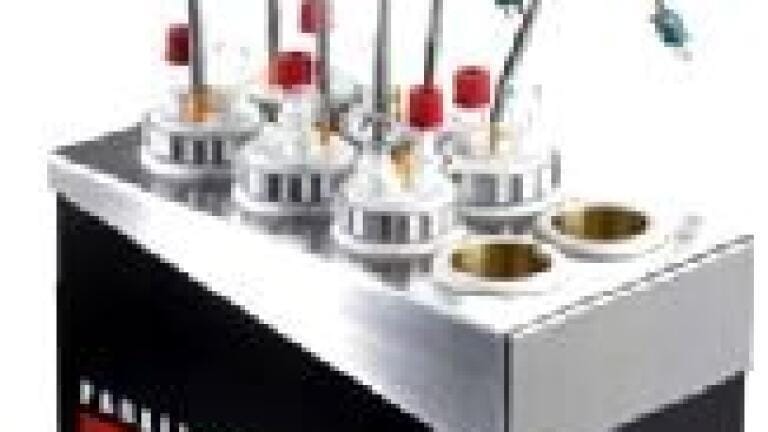
Scalable data from multi-reactor (parallel) systems is possible with careful attention to design, especially in relation to temperature, agitation and liquid dosing control. Polylock, from HEL Ltd, is rapidly becoming the industry standard for parallel chemistry and addresses these design features as follows:
- each of the 4 or 8 vessels in the polyblcok is at a separate temperature, controlled to within 0.1C of the set point, with software control of ramps down to 0.02C/minute and up to at least 5 C/minute. Temperature range from 60 to 250C is possible.
- agitation even down to vessels of 10ml in volume, is possible by means of a mechanical stirrer suspended on a shaft, giving uniform mixing of liquids, slurries and gases. For larger vessels (above 50ml), a range of conventional stirrer types can be supplied. The two versions of polyblock can cover volumes down to 2ml and up to around 500ml. Both glass and high pressure metal vessels are available.
- To replicate commercial processes, liquid or gas can be added independently to each vessel at user defined rates.
When combined with intuitive multi-vessel winISO software, the polyblock offers a platform that is versatile, extremely easy to use and which produces reliable (scalable) data.


 Product directory


.jpg)










.jpg)