Laboratory products
Published over 3 years ago. See the latest and most current information on Laboratory products.
Molecular distillation, also called high vacuum wiped film, thin film or short path distillation, is a well-known process to separate thermally sensitive material. Combined in a new unique construction with precise temperature control units, this allows high performance distillation for many different applications and products.
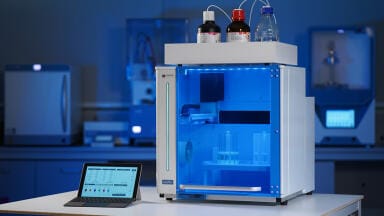
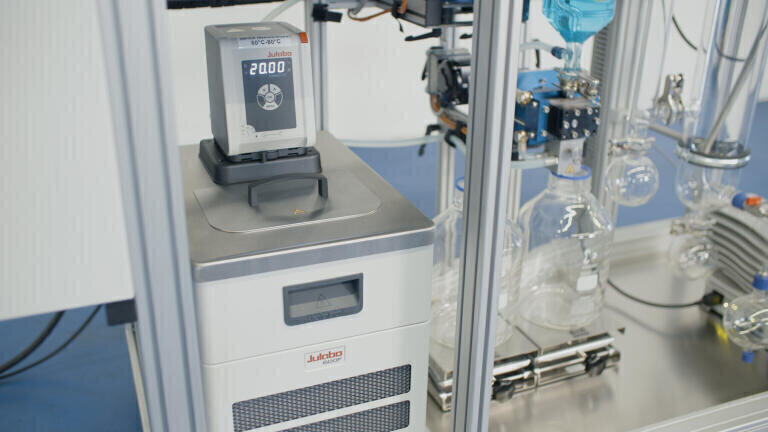
The SP 1000 CC from Pilodist GmbH is a turnkey system for laboratory use and small scale production. It is optimised to cover a wide range of applications, from high melting to high boiling points and can handle thermally sensitive material with full flexibility and completely continuous operation.
Beside typical applications like fragrances, (pre-)polymers or reactive chemicals, cannabis is one of the main application areas for the SP 1000 CC, as both short path and molecular distillation are required for optimal results.
In the first pass, the terpenes and light oils are distilled out at a pressure of ~1mbar abs. and an evaporator temperature of ~160°C. This light fraction is condensed at a glass cooling finger at ~30-40°C. Due to the chemical resistant dry running scroll pump, there is no risk of pump oil contamination in this step like in conventional rotary vane pumps of other systems.
The discharged residue fraction will be repassed to distil out the valuable cannabinoids and separate it from the tar-like waste fraction. This step is performed under high vacuum of 1x10⁻³ to 1x10⁻⁵ mbar and temperatures between 140-180°C. The cannabinoids like THC or CBD are condensed at temperatures between 60°C-80°C while the waste fraction with extremely high melting points is discharged tempered up to 200°C.
Due to the fully vacuum tight feed and discharge system, there is no limitation in the charge or receiver vessel size and the system can run in 24/7 operation without any interruption in the vacuum and a throughput up to 7l/h.
More information online
ILM 51.6 Sept 2026




 Product directory