Recent UK outbreaks of severe illness caused by Vero cytotoxin-producing Escherichia coli (O157 VTEC) have again highlighted the need for an effective means of isolating these bacteria from food and environmental samples. The combination of Lab M's immunomagnetic separation method (Captivate? O157 - CAP 001) and the company's specific chromogenic substrate medium for the isolation of E. coli 0157 (Harlequin? SMAC-BCIG HAL006) provides a highly sensitive solution.
E. coli O157 is one of the most important foodborne pathogens of animal origin. Associated primarily with self-limiting diarrhoea, it can also lead to much more serious conditions.
Low numbers, or overgrowth of E.coli O157 colonies by competing flora, can make the organism difficult to detect. Lab M's recommended protocol for enrichment and isolation uses both HAL006 medium and Captivate? O157.
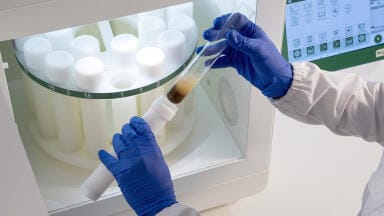
Six-hour enrichment in modified Tryptone Soy Broth (LAB165) at 42ºC is followed by immunomagnetic separation using Captivate? O157 particles and plating to HAL006, with or without the addition of cefixime tellurite supplement. E. coli O157:H7 appear as pale translucent colonies on this medium. Their identity can be confirmed using latex agglutination kits or appropriate antisera.



 Product directory