Mass spectrometry & spectroscopy
Published over 6 years ago. See the latest and most current information on Mass spectrometry & spectroscopy.
During trace and ultra-trace elemental analysis with ICP-MS, ICP-OES and GFAA, a number of external factors such as reagent purity and cross contamination can critically impact the sensitivity of instrumentation and are often the primary sources of error and the limiting factor for trace analysis. A range of systems from Analytix are dedicated to acid purification and ultratrace cleaning of vessels.
Chemical reagents used during analysis are often a major source of impurities. Acid distillation systems enable making your own ultrapure acids from reagent grade with up to 90% cost saving.
Sub-boiling distillation has been demonstrated to be the best method of acid purification and offers an optimal purification method for preparation of high purity reagents.
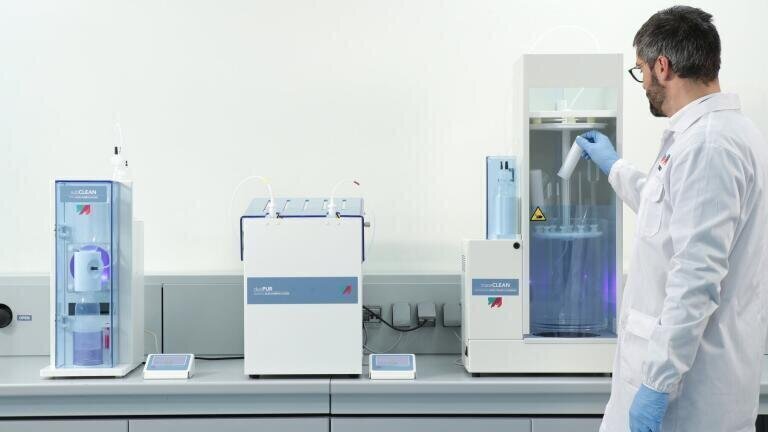
The Milestone SubPUR and DuoPUR have single and double quartz sub-boiling distillation units and are suitable for making commonly used ultrapure acids such as HNO3 and HCl. For making ultrapure HF, the SubCLEAN is a compact system where all parts in contact with acid are made of high purity PTFE.
All three sub-boiling distillation systems are available with an automatic filling and draining system that reduces the operator exposure to acids during filling and draining.
Cleaning various accessories used in trace analysis work requires soaking items in hot acids, often for several hours. Furthermore large volumes of acid are consumed and need to be changed regularly and there is also the risk of exposure to hot acids and acid vapours.
The Milestone TraceCLEAN is an automated, self-contained, acid steam cleaning system that thoroughly and safely cleans digestion vessels, inserts and AA, ICP-OES, ICP-MS accessories.
Only ultra-pure acid vapours come in contact with the surface of the items to be cleaned and clean components do not remain in contact with the cleaning acids after the surface contamination is removed.
More information online
ILM 51.6 Sept 2026



 Product directory


.jpg)
.jpg)




















.jpg)
