News
Published over 7 years ago. See the latest and most current information on News.
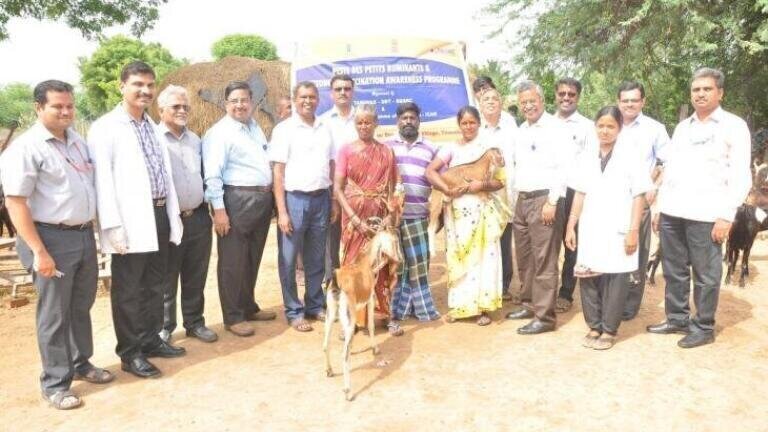
Four specialist organisations in India and scientists from the Pirbright Institute have recently completed a mass peste des petits ruminants (PPR) vaccination campaign and awareness programme based in Chennai. Peste des petits ruminants (PPR), also known as goat plague, is highly contagious and infects small ruminants such as sheep and goats, causing up to 90% mortality. The disease is prevalent across large parts of Africa, the Middle East, India and China and is estimated to cost between US$1.4 billion and US$2.1 billion globally each year.
Over the last four years the Pirbright Institute’s Vaccine Differentiation group has been working with the Tamil Nadu Veterinary and Animal Sciences University (TANUVAS), Indian Veterinary Research Institute (IVRI), National Institute of Animal Biotechnology (NIAB) and National Institute of Veterinary Epidemiology and Disease Informatics (NIVEDI) to coordinate the campaign, which has successfully uncovered important details about the PPR virus and generated tools to help eradicate the disease.
“Over 40 vets joined our campaign and we administered vaccines to over 400 sheep and goats in a single day. We also ran an awareness camp where we provided farmers and vets alike with expert guidance on diagnosing clinical signs of PPR and what measures they could take to reduce its spread”, said Professor Satya Parida from Pirbright, who led the collaborative effort with Dr Dhinakar Raj from TANUVAS.
The project was supported by a Farmed Animal Disease and Health (FADH) grant joint funded by the Biotechnology and Biological Sciences Research Council (BBSRC) and the Indian Government’s Department of Biotechnology (DBT).
The investigations have led the team to the filing of a patent application for a newly developed PPR vaccine, the first to differentiate between vaccinated and infected animals (DIVA) - a quality that enables livestock owners to protect their animals whilst continuing to trade. They also discovered how the PPR virus (PPRV) infects sheep and goats and by using a modified virus were able to demonstrate that PPRV primarily infects the tonsils, challenging earlier belief that the virus first replicates in the respiratory tract epithelial cells. Better diagnostic tests for use in the field and laboratory were generated and preliminary research identified why some Indian breeds of goats and sheep are resistant to the disease, raising potential for creation of PPRV resistant breeds in the future.
ILM 51.6 Sept 2026



 Product directory



























.jpg)
