News
Published over 11 years ago. See the latest and most current information on News.
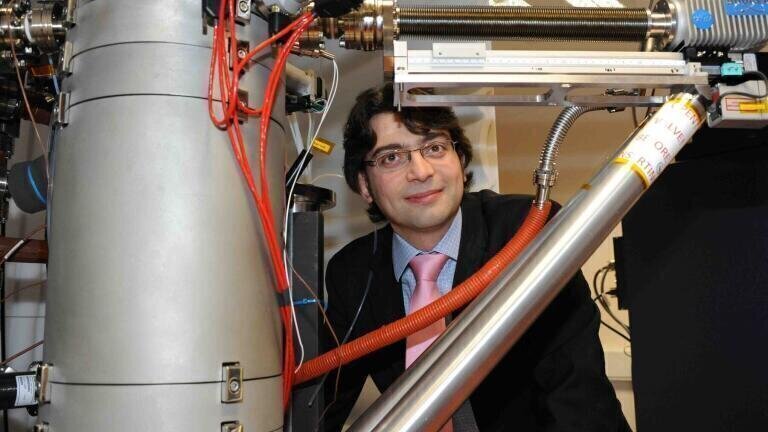
Researchers at the SuperSTEM National Facility at the Science and Technology Facilities Council’s Daresbury Laboratory UK, have defined the atomic fingerprint of 2D material molybdenum disulphide (MoS2), the active ingredient found in catalysts used by oil refineries across the world.
The research* was carried out and led by Danish catalysis and technology company, Haldor Topsøe A/S, in collaboration with the Lawrence Berkeley National Laboratory (USA). Using the SuperSTEM2 powerful electron microscope, one of only a handful of its kind in the world, they have been able to take the atomic fingerprint of molybdenum disulphide by imaging its individual atoms, one by one.
The images obtained disclose detailed knowledge about its structure at the atomic level, particularly around its elusive edges where, the team has discovered, the catalytic reaction can be made more powerful by the addition of single cobalt atoms. This capability provides a deeper understanding as to where impurities may lie, or where additives, such as cobalt, could be most effectively introduced to significantly boost the efficiency of catalysts.
Professor Quentin Ramasse, Scientific Director at SuperSTEM said: “What this research gives us is a deeper understanding into the atomic structure of molybdenum disulphide which could lead to significant improvements in the way industrial catalysts are fine-tuned in the near future, making them more efficient and cheaper to manufacture and upscale. This is chemistry at the single atom level working towards a new generation of catalysts for both a cleaner environment and positive economic benefits for industry.”
Dr Stig Helveg, co-author and senior research scientist at Topsoe, said: “These first-ever images show exactly how the individual atoms in the catalysts are arranged. Knowing this helps to explain what makes a catalyst good or bad. Such images are very difficult to obtain and we are working right at the edge of what is physically possible, simply because we need to distinguish each and every atom within the tiny crystallites of molybdenum, which are just a millionth of a millimeter in diameter.”
SuperSTEM is funded by the Engineering and Physical Sciences Research Council (EPSRC) and sits within the Sci-Tech Daresbury national science and innovation campus near Warrington, Cheshire.
Published in Angewandte Chemie.
ILM 51.6 Sept 2026

 Product directory













.jpg)
,-photo-Karin-Allander.jpg)