Chromatography
Published over 3 years ago. See the latest and most current information on Chromatography.
Due to the highly polar nature of oligonucleotides, hydrophilic interaction liquid chromatography (HILIC) is ideally suited for their characterisation. In this technical note, the separation of mixtures of short DNA (dT10, dT15 and dT20) and short RNA oligonucleotides (14, 17, 20 and 21mer) was used to examine important parameters for method optimisation in HILIC mode.
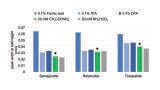
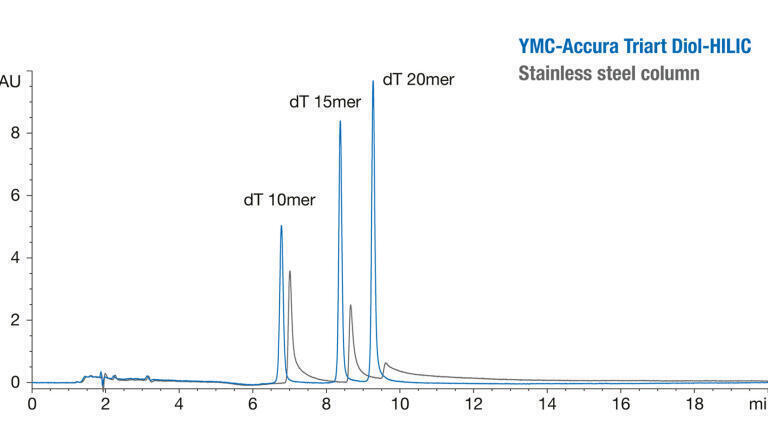
Oligonucleotides can be irreversibly adsorbed onto the metallic surface of the column hardware, due to their electron-rich backbone. The use of a bioinert coated YMC-Accura Triart Diol-HILIC column shows better peak shapes and higher sensitivity due to virtually no adsorption compared to the corresponding stainless-steel column (see Figure 1).
The influence of the sample solvent on peak shape especially for early eluting peaks is significant. As water is the strong eluent in HILIC mode, the ratio of organic solvent must be the same or higher than the initial gradient composition. The analysis of the DNA oligonucleotides diluted with a lower organic ratio (40%) shows that a higher injection peak as well as early eluting additional peaks occurs.
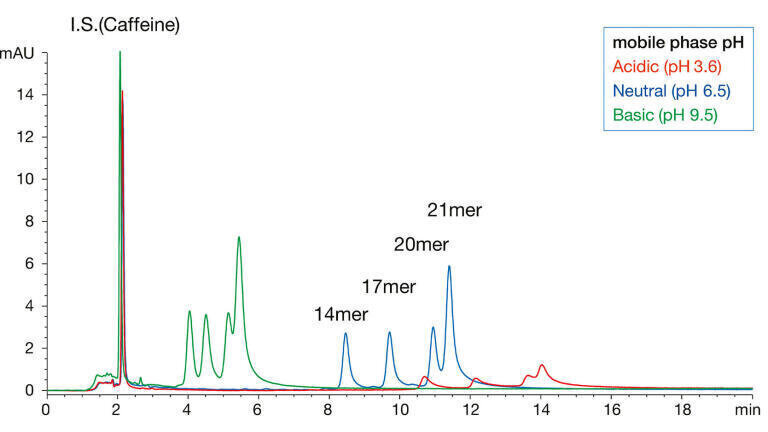
The mobile phase pH has a significant effect on retention and peak shape. Figure 2 shows that oligonucleotides are more strongly retained when the pH becomes lower. But with an acidic pH massive adsorption of the oligonucleotides occurs. Using the basic mobile phase, the retention is the lowest, but the resolution is visibly reduced, so that the neutral mobile phase pH shows the best results for this mixture.
These findings result in the following recommendations:
You will find further information about oligonucleotide analyses in YMC’s Oligonucleotide columns brochure.
ILM 51.6 Sept 2026


 Product directory