Laboratory products
Published over 16 years ago. See the latest and most current information on Laboratory products.
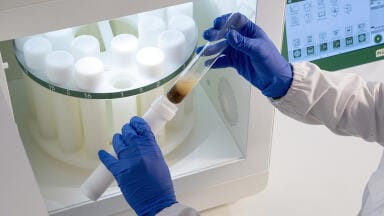
By using direct solid sampling technique samples can be measured without time-consuming preparation. Thus, total analysis time and blank problems caused by chemicals used for sample preparation are reduced to a minimum.
Sediments act as archives, where changing conditions can be traced for heavy metal cycling in the geo- and atmosphere. Thus the increased emission of trace elements related to industrial or mining activities is known to enhance significantly the total trace element concentrations in lake sediments as compared to natural background levels. In this respect, the metal concentration profile in sediments can be followed and besides active and passive contamination studies, renaturation programs of the water bodies can be configured.
In the following, a time efficient direct solid sampling technique for complex metallic matrices is presented and the advantages of the simplified line selection in the absorption spectrum are highlighted.
Download the Application note.
Sample preparation
The samples were analyzed directly without any further preparation.
Determination
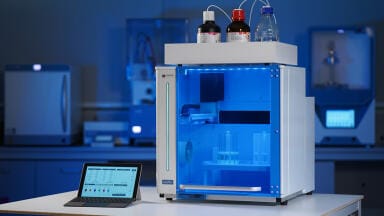
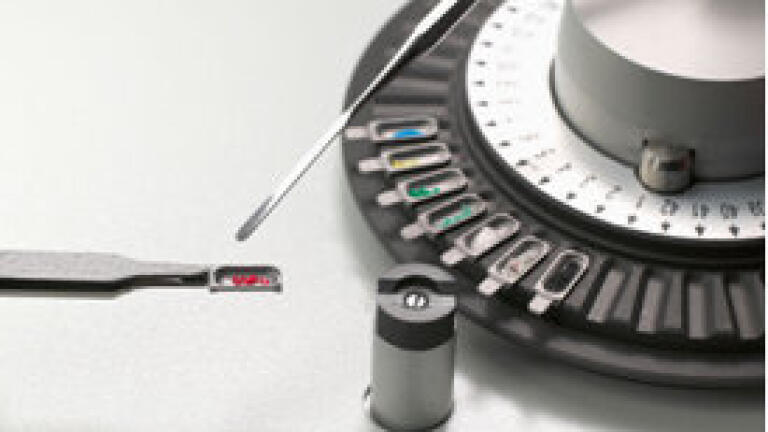
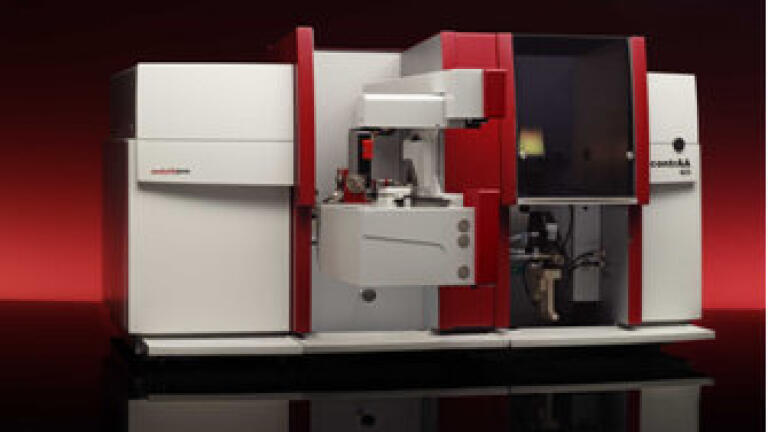
The measurements were performed with the High-Resolution Continuum Source AAS contrAA® and the full automatic solid autosampler SSA 600.
Method parameters
| Element | Wavelength | TPyr. | TAtom. | Ramp | Typical weight | Modifier |
| [nm] | [°C] | [°C] | [°C/s] | [mg] | ||
| Cd | 228.8018 | 650 | 2000 | 1200 | 0.2 - 0.4 | none |
| Pb | 368.3462 | 850 | 2450 | 1400 | 0.2 - 0.4 | 5 µL 0.1 % Pd(NO3)2 |
Evaluation parameters
| Element | Eval. pixel | Measurement time | No. of spectra | Spectral range | Background correction | |
| [s] | [pixel] | [nm] | ||||
| Cd | 3 | 3 | 90 | 200 | 0.25 | dynamic, with reference |
| Pb | 3 | 3 | 90 | 200 | 0.40 | dynamic, with reference |
Calibration
Cd
Solid calibration with reference material MESS-2 (certif. conc.: 0.24 ± 0.01 mg/kg)
Using different weights of MESS-2 between 0.1 and 1.2 mg
Standards: 1 replicate per statistic; integration mode: area
Samples: 5 replicates per statistic; integration mode: area
Pb
Solid calibration with reference material GBW 0831 (certif. conc.: 79 ± 12 mg/kg)
Using different weights of GBW 0831 between 0.1 and 0.6 mg
Standards: 1 replicate per statistic, integration mode: area
Samples: 5 replicates per statistic, integration mode: area
Results and Discussion
The spectral vicinity of Cd and Pb shows additional Fe lines at 228.7262 nm and 368.304 nm. Due to the high resolution of the spectrometer those signals could be separated from the analyte signal. High concentrations of Pb could be measured on an insensitive absorption line.
By measuring of reference materials recovery rates of about 92 and 95 % could be reached, proofing the analytical performance of the method employed.
| Element | Sample | Concentration [mg/kg] | RSD [%] | Recovery rate [%] |
| Cd | Sediment |
0.26 ± 0.06 |
7.6 | - |
| CRM 280 (*) |
1.48 ± 0.11 |
8.2 | 92.5 | |
| Pb | Sediment |
47.1 ± 2.5 |
6.5 | - |
| CRM 277 (**) | 139 ± 4 | 4.3 | 95.2 | |
|
(*) Reference material, certif. concentration of Cd: 1.6 ± 0.1 mg/kg (**) Reference material, certif. concentration of Pb: 146 ± 3 mg/kg |
ILM 51.6 Sept 2026


 Product directory