Laboratory products
Published over 2 years ago. See the latest and most current information on Laboratory products.
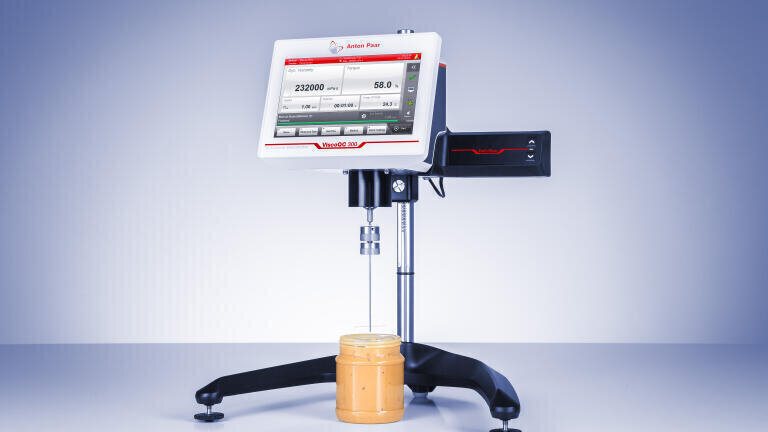
In the ever-evolving landscape of the food industry, precision and efficiency in quality control are paramount. Addressing the diverse needs of food manufacturers, Anton Paar’s ViscoQC 300 rotational viscometer emerges as a game-changer, offering an advanced solution for viscosity testing.
When measuring the viscosity of pasty, non-flowing samples (e.g., jams, bread spread, etc.) with standard cylindrical measuring geometries of a rotational viscometer, there is a risk in creating an air channel within the sample, which leads to incorrect measurement values as the spindle is no longer in contact with the product. The use of the motorised Heli-Plus accessory with T-bar spindles eliminates this channelling problem. While the spindle rotates, the viscometer automatically travels downwards through the sample resulting in a helical movement. This ensures that the spindle constantly is in touch with fresh sample.
At the heart of Anton Paar’s ViscoQC 300 capabilities is its ability to standardise test procedures through the revolutionary feature of digitally defining the start, immersion, and reversing positions of the measuring geometry. Recognising that different products may demand specific testing parameters, Heli-Plus empowers users to customise and save method-specific set points, ensuring that each test method adheres to the same predefined criteria, as the Heli-Plus is fully controlled via the viscometer. The result is a streamlined quality control process that minimises variations, enhances reliability, and ultimately contributes to the production of high-quality products.
In Scenario 1, tomato paste resists easy dispensing from the tube even with moderate pressure. Contrarily, in Scenario 2 a salad dressing effortlessly gushes out of the bottle with just a slight squeeze. Both of the mentioned products share a common quality control challenge referred to as ‘yield stress’. In simple terms, yield stress denotes the force necessary to initiate the flow of a fluid or soft- or semi-solids like puddings or sauces.
Yield stress testing is best carried out with vane spindles. The primary benefit of the vane spindle is that it imparts minimal disruption to the sample during spindle immersion. When immersed into the product, a portion of the test sample is trapped between the vanes, thereby creating a ‘cylinder’ of sample that can be used to calculate shear stress and ultimately the yield stress/point, providing complete flow curve data for viscosity analysis.
More information online
ILM 51.6 Sept 2026



 Product directory



















.jpg)
.jpg)
.jpg)