Laboratory products
Published over 6 years ago. See the latest and most current information on Laboratory products.
While the foundations for deep learning sate to the 1980s, researchers George Dahl and Abdel-rahman Mohamed broke new ground in 2010 when they developed advanced deep learning speech recognition tools. This paved the way for more deep learning advances focusing on anything from facial recognition to machine translation.
In 2011 a question-answering computer system developed by IBM's DeepQA project made headlines when it outplayed Brad Rutter and Ken Jennings, two of the most successful contestants to take part in the popular American game show Jeopardy!
Artificial intelligence took another stride forward in October 2011 when Apple launched Siri, it's signature personal assistant. From reciting the weather forecast to plotting a route on Google Maps, Siri is now used by hundreds of millions of people around the world.
In 2015 Google successfully pulled off "the world's first fully driverless ride on public roads" using its Waymo model. The passenger was a blind American man called Steve Mahan, a close friend of principal engineer Nathaniel Fairfield.
Perceptions of artificial intelligence were challenged in 2018 when a set of original paintings created by machines using Generative Adversarial Network technology sold for more than US$400,000 at a Christie’s auction. The portrait was created using a two-part algorithm that analysed image data from 15,000 portraits dating from the 14th to 20th centuries.
Artificial intelligence won more headlines in 2019 when Google launched an AI system that can detect lung cancer with more accuracy than human radiologists. The system is powered by deep learning and uses an algorithm to analyse computed tomography (CT) scans and predict the risk of developing the disease.
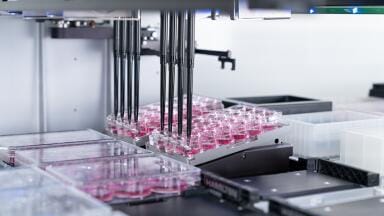
Want to know more about the most significant scientific breakthroughs of 2019? Introducing the latest technology from robotics company Andrew Alliance, 'Addressing the challenges of the reproducibility crisis with improved automation and protocol sharing' spotlights advanced laboratory automation and software infiltrating labs around the world.
ILM 51.6 Sept 2026



 Product directory


.jpg)
.jpg)








.jpg)
.jpg)
.jpg)




.jpg)
