Microtechnique news headlines from the American Institute of Physics reveal how a sideways glance at nuclei can allow the dynamics of molecules to be studied.
Rather than look at the nuclei themselves, a team from the City University of New York have been focusing on their orbiting electrons.
This allows information relating to molecular dynamics and chemical activity to be obtained in a way similar to nuclear magnetic resonance.
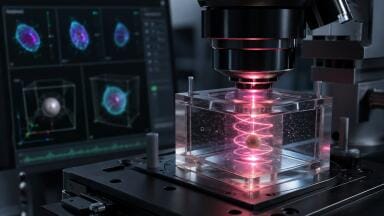
Response rates obtained are proportional to the length of the sample used, but not to its overall volume.
As a result, a short, thin tube of material could use mirrors to reflect laser light back and forth through the sample, achieving a greater signal amplitude without requiring greater amounts of matter.
The
microtechnique news could ultimately see strong signals obtained from microfluidic devices with a very small amount of material inside.
Recent reports from the University of California - Davis revealed attempts to make microfluidic platforms easier to use by creating a USB dongle to retrieve data from the systems on to computing equipment.




 Product directory