The latest
microtechnique news to come out of Purdue University takes the imaging of single-wall carbon nanotubes beyond the capabilities of optical and even atomic force microscopy.
Called transient absorption, the innovation is making
microtechnique news headlines - but is so precise it is arguably a nanotechnique in its own right.
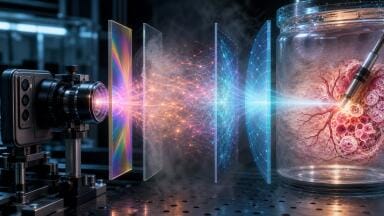
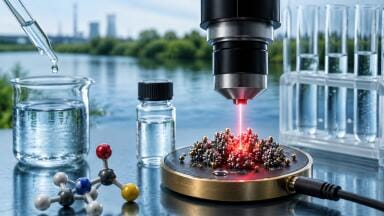
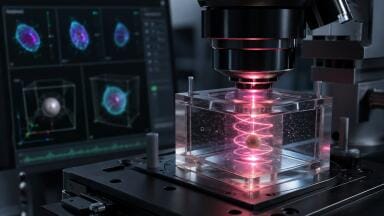
Ji-Xin Cheng, associate professor of biomedical engineering and chemistry at Purdue University, explains: "The imaging system uses a pulsing laser to deposit energy into the nanotubes, pumping the nanotubes from a ground state to an excited state."
This energy is then detected using a second 'probe' laser to identify the usable semiconducting nanotubes among the unwanted but unavoidable metallic by-product.
Being able to determine which of the tiny tubes are useful for electronics applications could accelerate the time to market of new systems, the researchers hope.
Purdue University is a campus-based academic institution with residences in Indianapolis, Fort Wayne, Westville and Hammond, all in Indiana.





 Product directory