News
Published over 14 years ago. See the latest and most current information on News.
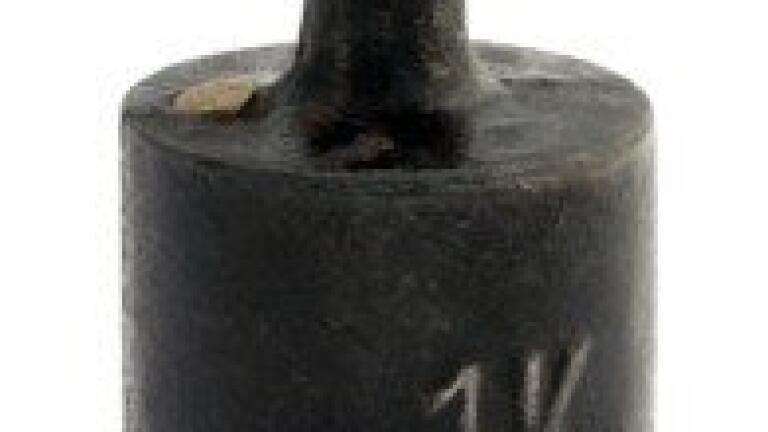
Since the introduction of the kilogram in 1889, the world has assumed that a kilogram was a kilogram, due to the International Prototype Kilogram (IPK) in France.
However, the metal cylinder, which has been kept under glass, has been secretly slimming down, changing its mass by around 50 micrograms.
Laboratories around the world rely on ultra-precise measurements and will view the kilogram's weight fluctuation as near-catastrophic.
Even though the cylinder is small enough to fit in the palm of a hand, scientists are now looking to use quantum physics to measure a true kilogram.
Alain Picard, director at the International Bureau of Weights and Measures, said that the cylinder, which was declared as unchangeable by its 19th century makers, had gained (or lost) the equivalent of a small grain of sand in weight, but that was enough to throw out calculations in everything from precision engineering to trade.
It will be replaced by the Planck Constant, named after Max Planck, which is the smallest packet of energy (or quanta) that two particles can exchange.
Posted by Ben Evens
ILM 51.6 Sept 2026



 Product directory