News
Published over 13 years ago. See the latest and most current information on News.
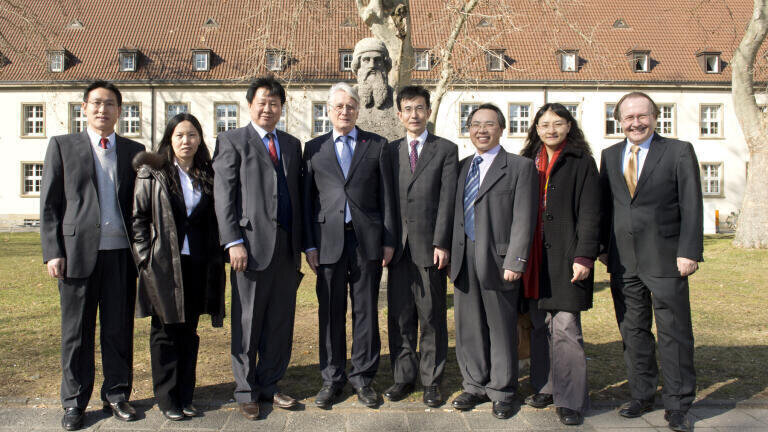
Researchers from Germany and China are collaborating in the study and development of Bio-Inspired Materials to ameliorate osteoporosis.
This Lighthouse project, initiated by the German Federal Ministry of Education and Research (BMBF) and supported with EU funding, is being carried out at a newly launched joint centre based both at the Institute of Physiological Chemistry at the Medical Centre of Johannes Gutenberg University Mainz (JGU) and at the Chinese Academy of Geological Sciences, together with Tsinghua University in Beijing, the Shanghai Institute of Materia Medica of the Chinese Academy of Sciences in Shanghai as well as other distinguished institutions in China.
The researchers will investigate substances that mimic structures and functions fabricated by nature. Lead investigator Professor Dr. Werner E. G. Müller of the Institute of Physiological Chemistry at JGU explained: "The inorganic structures of certain deep-sea organisms, such as sponges, are based on genetic blueprints. We will use those blueprints to develop synthetic bone replacement materials. Specifically and together with our Chinese partners, we are looking to create bio-inspired scaffolds from biosilica in the laboratory that can function as a basis for bone repair."
According to the molecular biologist, the potential of this research area is immense since such intelligent organic and inorganic materials have impressive properties, such as self-repair.
"Using 3D printing technology, we plan to develop tailor-made implants that make it possible to precisely correct a tissue defect and also to restore stability,"
For this purpose, a novel bio-inspired inorganic material will be used that is biocompatible and stimulates bone-forming cells. "This material gives the cells the ability to form new endogenous bone tissue," Professor Müller added.
ILM 51.6 Sept 2026

 Product directory














.jpg)
,-photo-Karin-Allander.jpg)