News
Published over 17 years ago. See the latest and most current information on News.
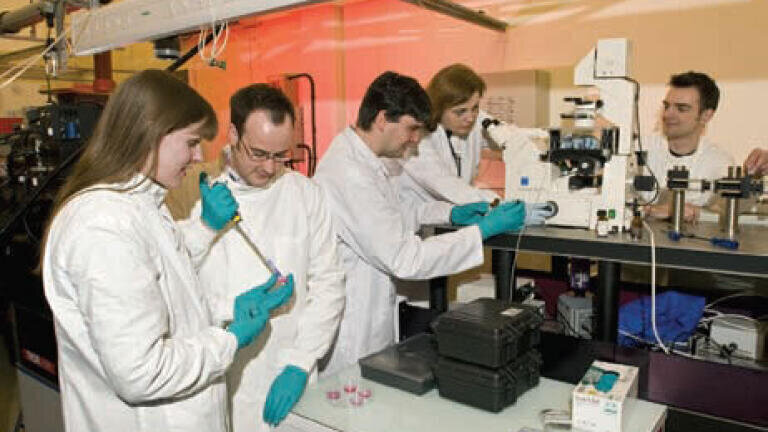
Scientists at the Science and Technology Facilities Council’s Rutherford Appleton Laboratory will begin preparatory experiments ahead of a major joint project with King’s College London. The aim of the work is to gain a better understanding of how new drugs could be developed to help treat cancer. Ultimately the scientists want to try and save more lives as well as money, by matching the right medication to the right patient. Using microscopes which have just arrived at RAL, King’s College London and STFC scientists are undertaking initial experiments
using funding from the STFC and King’s College prior to beginning the major project in September which will receive a £4.5 million grant from the Biotechnology and Biological Sciences Research Council (BBSRC). The idea is to begin examining a class of receptor molecules in much closer detail than has previously been possible.
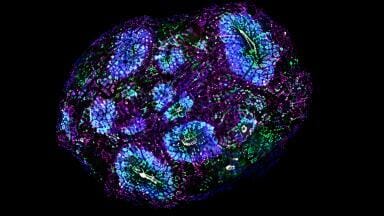
The sensitivity of the microscopes to individual molecules is combined with a new laser cluster which allows several molecular species to be lit up simultaneously. Together with state-of-the-art computational input from Oxford and Cambridge, this means for the first time, the individual behaviours of many different proteins will be examined within the context of their surroundings. This is vital for building up a
high resolution picture of how protein networks allow cancerous cells to replicate in the body and to address how interactions with drugs influence these molecular processes.
By examining as many as a hundred different molecular species and their interactions in living cells, the scientists hope to create a
network model, representative of all receptor associated molecular activity. The scientists ultimately hope to classify patients according
to the characteristics of their protein network interactions, so that predictions can be made about which drugs will be effective for
particular patients. At the moment the effectiveness of available drugs on individuals is not predicted.
Peter Parker, Head of the Division of Cancer Studies at King’s College London and Principal Investigator at King’s on this project, said; “The new targeted therapeutics in cancer promise a great deal in the clinic. However, on an individual patient basis, we are a long way from knowing exactly who will benefit and who will not. Understanding how particular drug targets behave at a fundamental molecular level and ultimately developing ways of monitoring this behaviour in tumours will impact enormously on the personalised medicine agenda.”
Marisa Martin-Fernandez – the STFC’s Principal Investigator for the work said; “It is like detective work … we will keep under surveillance families of proteins engaging with each other to find out when and how the wrong family members take control in cancer.”
Lab Asia 33.4 - August 2026



 Product directory