News
Published over 5 years ago. See the latest and most current information on News.
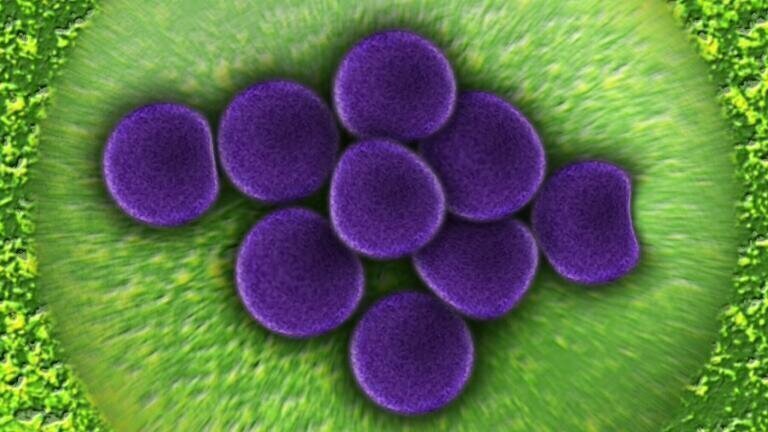
A research team led by the University of Sheffield has used high resolution microscopy techniques at STFC’s Octopus imaging cluster to investigate the properties of a compound which kills antibiotic-resistant superbugs. The findings have led to the development of a new compound that has killed antibiotic-resistant bacteria such as methicillin-resistant Staphylococcus aureus (MRSA) and E.Coli, during tests.
Despite having different cell wall structures, the new compound was found to be able to kill both gram-negative and gram-positive bacteria by passing through the cell wall of both forms and then binding to the DNA. Doctors have not had a new treatment for gram-negative bacteria in the last 50 years and no potential drugs have entered clinical trials since 2010, so this research could lead to new treatments for these antibiotic-resistant superbugs.
The Octopus imaging cluster, part of the UK’s Central Laser Facility located in Harwell, Oxfordshire, allowed the researchers to look at how the new compound moves and act using a super resolution microscopy technique, Stimulated Emission Depletion (STED), using a specially developed dye to show fluorescence in the compound.
Dr Jorge Bernardino de la Serna from Imperial College London was part of the research team, bringing expertise from his former role as a spectroscopist at CLF and continuing visiting scientist at the facility. He said: “The cellular laboratories at CLF, equipment capabilities and know-how of the experienced staff within Octopus has been instrumental to be able to resolve the mechanism of action of this antimicrobial at the nanoscale. The ruthenium-based dyes uniquely display fluorescence properties which can nicely resolved employing a type of super resolution microscopy, STED (Stimulation Emission Depletion).”
The University of Sheffield’s Professor of Bio-inorganic Chemistry Jim Thomas led the research team. He said: "The identification of these novel antimicrobials and their mode of action has been greatly accelerated by the intrinsic luminescent properties. To be able to probe their uptake, intracellular localization and directly see how they kill bacteria at the amazing resolutions supplied by STED has been a huge catalyst in their development."
The research was published in Chemical Science.
ILM 51.6 Sept 2026



 Product directory























.jpg)
