Chromatography
For many methods existing/proven methods are on the books. Many applications you can find at the vendors using their instrumentation and columns.
Now there is a new tool available anybody can use from the web. It’s called ProEZGC and it’s basically a GC in your laptop. This program has now also been completed with PLOT columns like Alumina, Molsieve 5A and Porous polymers. These are the “to go” columns for volatile separations.
Now you can enter the list of analytes YOU are interested in and change. Oven program, linear gas velocity, type of carrier gas or using a different column dimension.
This means setting up a new method or modifying an existing method you do not need a GC or time to develop new parameters. And… its 100% free.
In GC there is always an interest to optimise separations with respect to resolution or costs of operation. Practically this takes a lot of time and investments which many labs have no budget for.
About 10 years ago a free web program came available that simulates GC separations [1, 2]. You could enter the components you needed to resolve, and the program provided separations on several GC phases. You can choose a chromatogram and now you can change all GC parameters: You can change carrier gas (moving to H2 or N2), use a different column dimension (shorter, other diameter, film thickness, run at higher linear gas velocity or move to a different detector like a MS. This allowed you to save a lot of time before even touching a GC.
When I visit any big lab with many GC, they tell me that they know at least 30% of applications is not optimised, but they cannot work on a better method as the GC has to produce data and they can only do this, if they have a spare GC to setup in same configuration and a specialist to do the work.
Now it’s a matter of changing the application using this digital tool and the GC has to be taken out of application for just 5-10 minutes to run the new, optimised method. All saving a lot of time.
This internet application only worked with liquid phases until now but is now upgraded to help also with Gas Solid applications.
The modeler was only applicable for Gas-Liquid separations using modified polydimethyl siloxanes of different polarity,
Recently also adsorbents were added which greatly expanded the application. Databases were added om Alumina, covering 3 alumina selectivity’s, porous polymers, covering 4 selectivity’s, and molecular sieves 5A.
In order to predict separations, all components in the database were ran at 3 different oven programs under exactly controlled conditions.
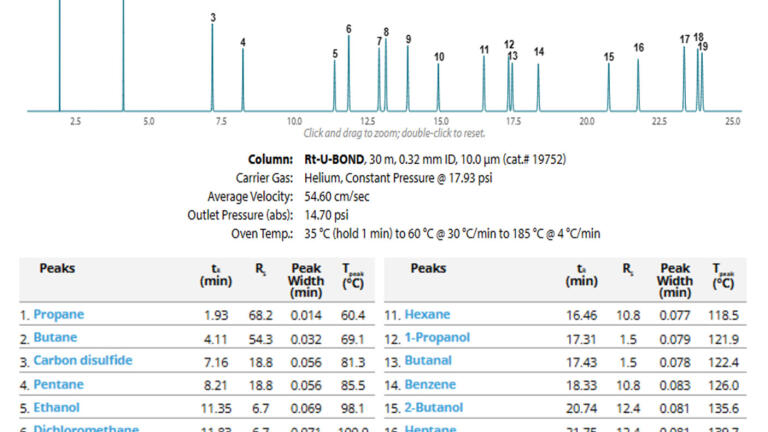
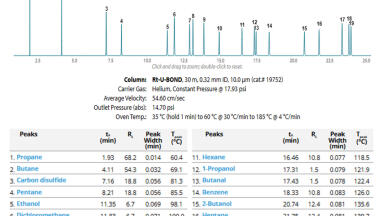
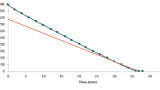
Figure 1 shows an EZGC example of volatiles on a U-type porous polymer and Figure 2 shows how well the predicted elution time matched the real data. Here a series of hydrocarbons were analysed using EZGC (Simulation) and real (Empirical)
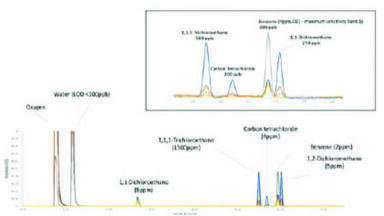
One can change oven conditions, carrier gas, velocity, column dimensions also. An interesting chromatogram is shown in Figure 3. Many users want to have better separation between Argon and Oxygen. At 30ºC you just get a base line separation, but injection errors always will broaden the early eluders. So, we ran the analysis at 1C (just put the Molsieve 5A capillary in an ice bath.
Neopentane is an impurity in C4 hydrocarbons streams, such as 1,3-butadiene, n-butane, and butylene. It is used in a variety of applications from the production of adhesives, paints, and inks to the blowing agent in the production of polystyrene foam.
While neopentane analysis is performed more frequently than in the past, chemists often have difficulty separating neopentane from other hydrocarbons due to column limitations.
The unique stationary phase of Rt- Alumina BOND/MAPD columns is highly selective for C1-C5 hydrocarbons, offering excellent separation of neopentane and other impurities.
The high loading capacity provides symmetrical peaks, making these columns ideal for impurity analyses at ppm concentrations.
Separations on alumina are very much influenced by temperature and flow [3].
Using the Pro EZGC platform the flow and temperature program could be changed, and you can directly see the impact, see examples in Figures 4 and 5. By using slower temperature program, the neopentane elutes at about 40ºC lower temperature and elutes now completely free. One can also use a fixed oven program and change the flow rate, see Figure 5. Also, here we see the neopentane moves away from its neighbours when higher flows (= lower elution temperatures) are used.
The simulation of GC separations has been further expanded with gases and volatiles using several types of PLOT columns.
The program is basically a GC in your laptop and before actually running the real GC, one can optimise easy the conditions by changing carrier gas, oven program, flow or choosing different columns.
All saves a lot of time in application optimisation and development. The ProEZGC is freely accessible from the Restek website, you only need to create a login and a password.
ILM 51.6 Sept 2026


 Product directory


.jpg)
.jpg)













.jpg)
