Safety
A new generation of gas detection tools is helping operators of gas distribution pipelines and processing plants meet tougher methane emissions regulations, reduce risk, and slash survey times.
A quiet revolution is reshaping the way operators detect natural gas leaks. From satellites to handheld infrared (IR) tools, a new generation of technologies is making detection faster, more precise, and far easier to manage.
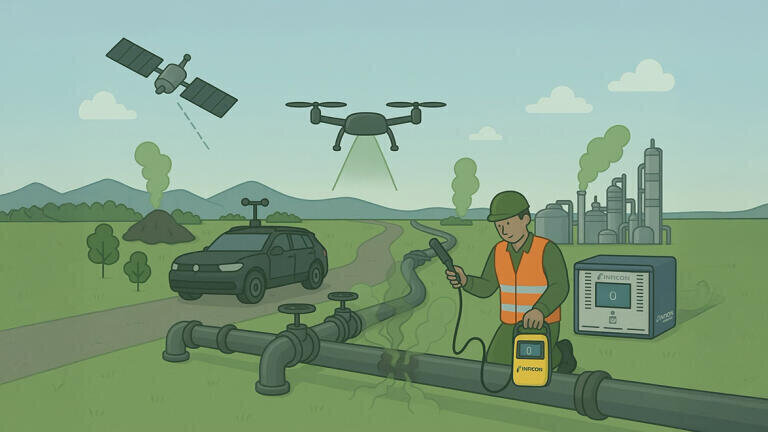
While no single solution fits every situation, combining the right tools—satellites, drones, laser scanners, and portable IR detectors—enables a comprehensive and precise approach. The new technologies are non-invasive, easy to work with, and often deliver results in a format that can be easily stored and uploaded.
Together, these tools bring leak detection into the digital age, improving safety, compliance, and cost efficiency while providing vast efficiency improvements to gas network survey processes.
However, the industry is moving slowly, and legacy gas detection methods still dominate in many areas.
Leaking natural gas can be difficult to detect in urban areas. Contaminants such as car exhaust fumes, or even humidity, could trigger false alarms with some types of instruments.
Still, operators of gas processing plants and pipelines must be able to detect leaking gas to protect workers and the public from harm, prevent loss, and reduce environmental impact.
The issue has taken on new urgency due to methane’s high global warming potential—80 times greater than carbon dioxide over a 20-year period. As a result, governments are tightening regulations.
The EU Methane Regulation (2024/1787), which came into force in the second half of 2024, is setting a new global benchmark. This ambitious legislation requires energy gas producers to significantly cut methane emissions, not just within the EU but across the entire global supply chain, if the product is bound for the European market.
Several U.S. states have introduced similar rules, making leak detection not just best practice but a legal requirement.
Traditional leak detection methods rely on chemical reactions. Flame ionization detectors (FID), for instance, burn gas and measure the resulting ionized particles.
While accurate, these tools are heavy and cumbersome. Semiconductor sensors tend to be lighter and fast but less reliable and repeatable over time. They can also take a long time to reset after a larger gas exposure.
Modern IR absorption technology sidesteps chemical reactions entirely. It measures the specific wavelengths of light absorbed by gas molecules, enabling non-contact detection and faster results.
Most laser-based instruments in the market are intended for remote scanning of areas to detect the presence of gas, while handheld IR detectors are used for pinpointing the exact location and quantification of leaks or emission rates.
Satellites and drones can extend the coverage to entire regions or to isolated areas, enabling a scalable detection strategy.
To confirm and locate leaks, it is necessary to get down to ground level with a hand-held IR instrument.
Infrared instruments for work at close range analyze samples from the atmosphere in a chamber inside the instrument.
An assortment of attachments, similar to those used with traditional close-range detectors, has been developed to help pinpoint the location of leaks using an IR instrument, such as probes for getting into cavities and corners.
For inspecting underground gas lines, a small trolley with an air-trapping mat can be pushed along the pipeline route above ground.
Once gas has been detected, it needs to be analyzed to determine whether it is from a pipeline leak or just naturally occurring methane, also known as swamp gas. Both swamp gas and natural gas contain methane.
But natural gas also has a component that does not occur in swamp gas, and this is ethane. So, the presence of ethane is the marker for natural gas.
Connectivity is one of the big wins with the use of these technologies. Modern IR detectors often feature Bluetooth and GPS, allowing seamless data logging and geotagging.
This streamlines reporting and enables more effective survey planning and regulatory compliance.
Intero -The Sniffers, a global inspection company serving clients like Shell and Aramco, has seen business surge as demand for methane monitoring grows.
Operations director Bas Hermans says the shift is clear: “Everyone in this sector is moving to infrared and laser. These instruments are far easier to work with than the older technology.
“One particular advantage of the IR instrument that we use is that it has a Bluetooth connection that we can use with our own software. The data is logged and uploaded within seconds, making the record keeping so much easier.”
Atlanta-based Southern Cross, a manufacturer of FID systems for many years, is now pivoting toward digital tools.
Alnoor Ebrahim, who leads advanced technology and strategy, says IR detectors with GPS and Bluetooth represent the future.
“Demand for IR is increasing. With GPS and Bluetooth, you get accurate recording of results, with geopositioning and automatic data gathering.
You can even choose if you want the results in ppm, percentage of gas, or percentage of the lower explosive limit – different client companies want the results presented in different ways,” says Ebrahim.
As sales of FID systems are tailing off, the company is increasingly becoming a leading distributor of instruments from other manufacturers and an expert on gas detection across the board.
“There is still a hard core of people that use FID and will continue to do so for the next few years. But this group is shrinking,” Ebrahim says.
One of Southern Cross’ customers, Cullman-Jefferson Counties Gas District, operates a 1000-mile gas network in central Alabama, based around the Birmingham to Cullman gas pipeline.
The organization has, until recently, operated FID instruments and other legacy technologies to detect leaks in valves and pipelines, but is now phasing out such equipment.
“We are making massive savings. We have a legal requirement to undertake periodic gas network surveys to search for leaks. It is one of our most costly operations. Surveying one-fifth of the network used to take us four to six months.
Now, this can be achieved in two and a half to three months, saving somewhere between one-third and half the time required,” says Keith Blackwood, director of construction and engineering at the utility.
Blackwood and his team use an infrared leak detector from INFICON, IRwin, which means gas samples no longer need to be sent off for analysis, as the built-in gas chromatograph reveals the content of a sample in less than a minute.
Additionally, the need to drill bar holes has been eliminated, as the location of the leak can be accurately pinpointed by pulling gas through paved surfaces with a vacuum bell.
Natural gas may one day be phased out in favor of hydrogen. Hydrogen is non-polluting but still flammable, and it has different properties compared to natural gas.
Hydrogen detectors already exist, but they require further development for field use in energy gas networks, including Ex classification for explosive environments.
But the likely next step in energy gas distribution will be hydrogen blended with natural gas. That means today’s IR tools are likely to stay relevant for years, for as long as some natural gas remains in the mix.
Lab Asia 33.2 April


 Product directory