News
Researchers at McMaster University have identified manikomycin, a novel antibiotic candidate that attacks a previously unknown ribosomal target in dangerous Gram-negative bacteria, including Salmonella, Escherichia coli and Klebsiella
Researchers at McMaster University, Hamilton, Ontario, Canada, have discovered a novel antibiotic candidate that can kill some of the world’s most dangerous drug-resistant bacteria by exploiting a previously unknown vulnerability in the bacterial ribosome.
The compound – called manikomycin – was identified by a team led by Professor Gerry Wright and has shown early activity against priority pathogens including Salmonella, Escherichia coli and Klebsiella. These bacteria are of major concern because they can cause serious infections and – in some cases – have developed resistance to multiple existing antibiotics.
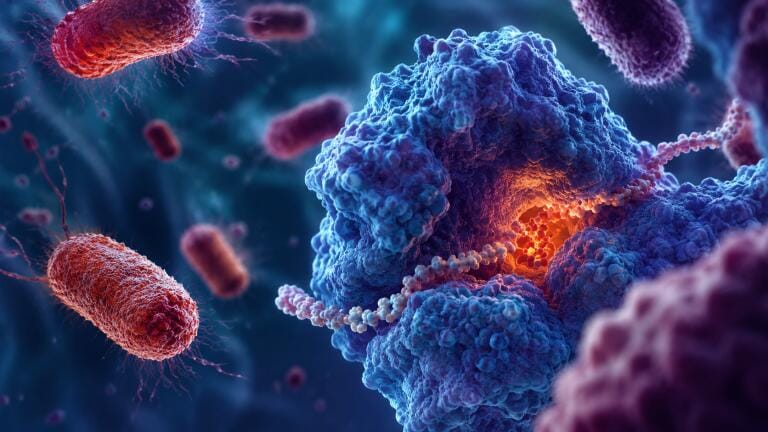
Unlike antibiotics currently used in clinical practice, manikomycin acts by blocking the exit site of the ribosome, the protein-producing machinery found inside every bacterial cell. The ribosome is essential for life because it translates genetic instructions into proteins, which bacteria need to grow, divide and survive. By obstructing the exit route through which newly made proteins must pass, manikomycin appears to stop this process at a critical point.
The discovery marked the fourth antibiotic candidate to emerge from Wright’s laboratory in little more than a year. The finding has highlighted a promising route for antibiotic discovery at a time when antimicrobial resistance continues to threaten modern medicine.
“Not a single antibiotic prescribed in clinics today does what manikomycin does,” said Wright, a member of the Michael G. DeGroote Institute of Infectious Disease Research.
“Not azithromycin, not tetracycline – none of them. So, we’ve not only found a brand-new drug candidate but we’ve also established a brand-new target in bacteria that could potentially be exploited with other novel drugs,” he said.
The target has attracted particular interest because many existing antibiotics act on the same limited set of bacterial weaknesses. In response, bacteria have evolved broad defence mechanisms, including molecular pumps that expel drugs, enzymes that modify or destroy them and mutations that alter drug-binding sites. Wright said that manikomycin’s mechanism was different because it attacked a part of the ribosome that has not been subject to the same long history of antibiotic pressure.
“Even newly discovered drugs that attack those same old targets may quickly face resistance,” said Wright, a professor in McMaster’s department of biochemistry and biomedical sciences.
“But, over the history of medicine, we’ve put absolutely no selective pressure on this particular target, so bacteria have no existing resistance mechanisms for manikomycin,” he added.
Wright compared the ribosome with a factory assembly line. In this analogy, finished components must be moved off the line before the next item can advance. Manikomycin blocks the end of that production line which causes the entire assembly process to jam up and be brought to a stop. Without the ability to produce functional proteins, bacteria won’t remain viable.
The discovery of manikomycin has built on research that began more than 75 years ago, when scientists first found that the soil bacterium Streptomyces rimosus (S. rimosus) produced oxytetracycline. Oxytetracycline became one of the important antibiotics that helped to establish the modern antibiotic era, alongside other natural products isolated during the middle decades of the twentieth century.
However, S. rimosus and related bacteria have since been considered by many researchers to be exhausted as sources of novel antibiotics. For decades, pharmaceutical research increasingly moved away from such familiar organisms because many screening campaigns repeatedly rediscovered known compounds rather than clinically useful novel molecules.
“There is an overwhelming perception in science that these bacteria have been mined completely dry – that we’ve found all there is to find. Our lab has found that this is not at all the case,” said Wright.
Wright’s group, in collaboration with researchers at the University of Illinois Chicago and the University of Hamburg in Germany, used an advanced laboratory technique called fractionation to search more deeply within the chemical mixtures produced by S. rimosus. Fractionation allows scientists to separate complex mixtures into smaller chemical fractions so that rare molecules can be detected and assessed individually.
By filtering out oxytetracycline and other abundant compounds, the researchers were able to identify scarcer molecules that had remained hidden despite decades of study. This approach allowed them to move beyond the dominant chemical signals that had previously masked potentially valuable antibiotic candidates.
“There is likely so much still to be discovered through fractionation,” said Dr. Manpreet Kaur, a fellow in Wright’s laboratory and first author of the study.
“Revisiting the extracts of even well-studied bacteria like Streptomyces may lead to similar discoveries in the future,” she said.
The team has now started to advance manikomycin towards clinical development. Early studies have shown that the antibiotic candidate was not toxic to human cells and that it performed well in a controlled laboratory model of infection. These findings represent important early milestones, although further development will be required before the compound can be assessed in human trials.
The researchers are also working to optimise the drug’s residency time, which refers to how long it remains active in the body. This is an important pharmacological property because an antibiotic must persist for long enough – and at sufficient concentrations – to suppress or eliminate infection without unacceptable toxicity.
The team has produced 60 derivatives of manikomycin and plans to select the most promising version for further development. Such chemical modification is a standard step in antibiotic optimisation, as researchers seek to improve potency, stability, safety, tissue distribution and spectrum of activity.
“We’re excited about this molecule’s potential,” said Wright.
“There’s a clear path forward and we may even be able to expand its spectrum so that it eventually affects even more bacteria too.”
The discovery has suggested that long-studied antibiotic-producing bacteria may still contain overlooked chemical diversity. It has also provided evidence that the bacterial ribosome still holds underexplored targets, despite its central role in antibiotic therapy for more than half a century.
If manikomycin or related molecules can progress through further preclinical and clinical development, the work could open a route towards a distinct class of antibiotics at a time when novel antibacterial strategies are urgently needed.
ILM 51.6 Sept 2026



 Product directory




















.jpg)
