Research news
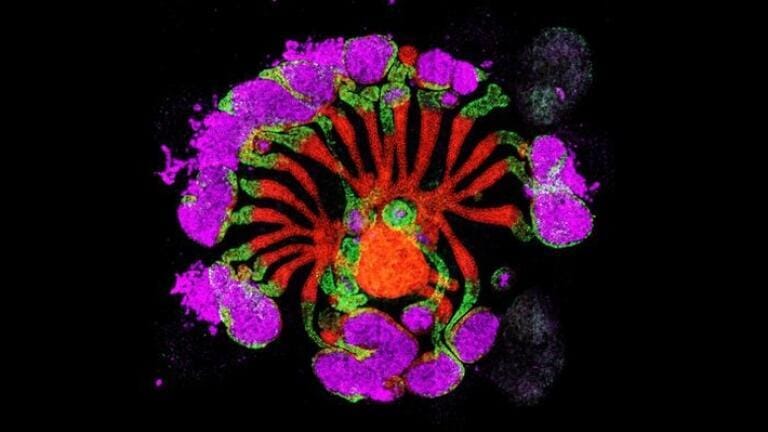
Researchers at the University of Southern California have developed highly complex human synthetic kidney organoids that reproduce key aspects of kidney structure and function, with potential applications in disease modelling, drug safety testing and regenerative medicine
A team led by Professor Zhongwei Li at the University of Southern California, Los Angeles, USA, has produced some of the most complex and mature laboratory-grown kidney models reported to date, with the work set to support research into kidney disease, drug toxicity and the longer-term possibility of regenerative therapies for patients who require transplants.
The project has been supported by a multi-year grant from the California Institute for Regenerative Medicine, San Francisco, USA. Li and colleagues have now started to map the characteristics, structure and function of these miniature kidney-like structures, known as human synthetic kidney organoids, to assess how closely they reproduce the biology of human kidneys and how they could be used to study disease.
Human synthetic kidney organoids are tiny organ-like systems grown from human stem cells. Although they remain far from transplantable organs, they offer a powerful experimental platform because they can reproduce aspects of kidney organisation that are difficult to study in conventional cell cultures. In the near term, the organoids could help researchers to investigate chronic kidney disease. They could also help to model condition such as autosomal dominant polycystic kidney disease which is an inherited disorder where fluid-filled cysts enlarge within the kidneys interfering with function.
“This novel model has features not seen in other kidney organoids, because structures are arranged in the right pattern and connected to one another. That organisation is essential to replicate the organ’s function,” said Li, who is associate professor of medicine and stem cell biology and regenerative medicine at the Keck School of Medicine of the University of Southern California and served as principal investigator for the project.
The kidney is one of the body’s most structurally and functionally complex organs. It filters waste products from the blood through an intricate system of specialised cell types, to regulate fluids and electrolytes balance and then produce urine. These cells must form filtering units, transport tubules and collecting structures in the correct arrangement. Earlier kidney organoids could recreate some components of this system, but they could not integrate them into a connected architecture that more closely resembles the native organ.
The team reported a significant step forward in a paper in 2025 where they described the creation of human synthetic kidney organoids, also known as human kidney progenitor assembloids. These structures combined kidney filtering and urine-collecting components reproduced some of the organ’s complex architecture and filtered blood after they were transplanted into mouse models.
The method drew on the way kidneys form during embryonic development. Li reasoned that, because embryonic kidney cells have a strong capacity to organise themselves into defined patterns, it should be possible to assemble the correct progenitor cells under conditions that would allow them to form kidney-like structures. Over the past decade, the team has refined the culture of two types of kidney progenitor cell.
The researchers created separate organoids from each progenitor cell population and tested multiple chemical formulations to identify a nutrient-rich culture environment that could support complex, organised cellular networks. When the two types of organoid were brought together under the correct laboratory conditions, they formed a kidney-like system. The researchers then transplanted these structures into living mice to promote further maturation. The resulting human synthetic kidney organoids showed patterns of gene activity, hormone production and other biological functions that were partly similar to those observed in mouse and human kidneys.
The next stage of the programme will assess how these organoids mature over time and how effectively they perform key kidney functions. The team will also use the models to study polycystic kidney disease which has been difficult to investigate in its earliest phases because researchers usually have access only to tissue samples from advanced disease.
“It’s important to intervene at the early stages of a disease but we haven’t had tools that allow us to study this period of polycystic kidney disease. Our organoids may change that,” Li said.
By applying advanced genetic and molecular analysis tools, the team aims to observe how the first cysts form and to explore possible treatment strategies. The organoids could therefore provide a rare window into the earliest cellular events that lead to progressive kidney damage.
The researchers will also generate human synthetic kidney organoids from eight stem cell lines that represent male and female donors from Caucasian, African American, Hispanic and Asian populations. This part of the work could allow scientists to study how kidney disease biology varies across population groups and may help to address long-standing gaps in biomedical research.1
Beyond disease modelling, functional kidney organoids could support drug development by helping pharmaceutical companies to identify compounds that are likely to damage the kidney before they enter clinical trials. Kidney toxicity remains a major reason why investigational medicines fail, with about one in ten candidate drugs affected by this problem during clinical development. Models that better predict human kidney toxicity could reduce risk, cost and delay across the drug development pipeline.
“If these models can accurately predict kidney toxicity before a drug enters clinical trials, they could make a major contribution to drug development,” Li said.
In the longer term, the work may also contribute to efforts to build laboratory-grown kidney tissue for transplantation. That goal remains scientifically and technically demanding, not least because a transplantable kidney would need to reproduce the full architecture, vascular supply and functional capacity of the natural organ.
For further reading please visit: 10.1016/j.stem.2025.08.013
ILM 51.6 Sept 2026



 Product directory




















,-photo-Karin-Allander.jpg)





.jpg)
