Research news
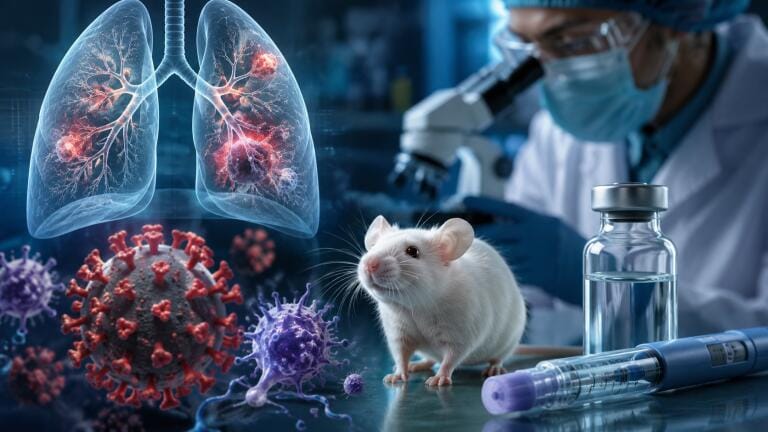
Mouse experiments have suggested that glucagon-like peptide-1 receptor agonists may reduce pulmonary fibrosis following a COVID-19 infection in people with type 2 diabetes, although researchers cautioned that the findings remain preliminary
Glucagon-like peptide-1 (GLP-1) receptor agonists, already used to treat type 2 diabetes (T2DM) and obesity, may also help to reduce the risk of COVID-19-related lung scarring in people with T2DM, according to research in mouse models.
The findings have suggested a possible route to protect a high-risk patient group from pulmonary fibrosis, one of the most severe long-term complications associated with Long COVID. The research focused on people with T2DM who developed persistent lung damage months or years after infection with COVID-19.
“People with T2DM have way more severe infections and infection-related severe disease after COVID-19 than other people,” said Dr Runhong Zhou, a virologist at the University of Hong Kong and study leader, who studies the interactions between viral infections and the immune system.
Dr Zhou said previous studies had estimated that people with T2DM faced a risk of severe Long COVID symptoms four times higher than that of people without T2DM, although the biological mechanisms behind this increased risk had remained poorly understood.
“We wanted to know why these people have long-term symptoms,” Dr Zhou said.
Pulmonary fibrosis is a progressive lung disorder in which normal lung tissue becomes scarred and stiff. In Long COVID, this scarring can follow severe inflammation after infection and can make it harder for oxygen to pass from the lungs into the bloodstream. The condition can lead to breathlessness, persistent cough, fatigue and reduced exercise tolerance. A key part of the process involves macrophages, immune cells that help to repair tissue after injury but can also drive excessive scar formation when immune responses fail to resolve properly.
Dr Zhou undertook the work while he was a researcher in the laboratory of Professor Zhiwei Chen, also at the University of Hong Kong. Professor Chen has studied immune responses and the immunopathogenesis of coronaviruses in animal models since the severe acute respiratory syndrome (SARS1) outbreak that began in China in November 2002.
To examine how T2DM may contribute to persistent lung symptoms after COVID-19, the researchers first compared blood samples from people with and without T2DM. These samples had been used in an earlier COVID-19 study and had been collected at three distinct time points after hospital admission.
At the third time point, several months after hospitalisation, the researchers found differences in levels of monocytes, a class of white blood cell that can mature into macrophages. In people with T2DM, the team also identified increased activity in genetic pathways associated with monocytes and linked to the onset of fibrosis.
The researchers then used mouse experiments to test the relationship between T2DM, COVID-19 infection and pulmonary fibrosis. These experiments showed that numerous fibrosis-related genes had become excessively active in infected mice with T2DM, in a pattern similar to that observed in infected people. Under normal conditions, many of these genes help the body to produce fibrous proteins needed for wound repair and tissue structure. When such pathways remain abnormally active, however, they can contribute to the formation of harmful scar tissue.
“We wanted to figure out what kind of treatment may prevent this in the mouse,” Dr Zhou said.
The team focused on GLP-1 receptor agonists because the GLP-1 receptor is highly expressed in lung cells. Dr Zhou said laboratory studies had also suggested that GLP-1 agonists could have anti-inflammatory effects in fibrosis linked to pneumonia. However, he had not seen the drugs tested in animal models after severe COVID-19 infection.
When the researchers treated the mice with GLP-1 agonists, the drugs appeared to normalise fibrosis-related genes and to ‘reprogramme’ the macrophages that contributed to scar tissue accumulation. Mice that received GLP-1 agonists developed less pulmonary fibrosis than untreated mice, which suggested that the drugs could reduce fibrous tissue build-up after infection.
Dr Zhou cautioned that the findings remained preliminary. The study provided proof of concept and involved only a small number of mice, which means the results cannot yet show whether the same approach would benefit people with T2DM and Long COVID. Further research, including larger animal studies and carefully designed clinical trials, would be needed before GLP-1 agonists could be considered as a treatment for pulmonary fibrosis associated with COVID-19.
Even so, the findings have raised the possibility that a drug class already widely used in metabolic disease may also influence immune pathways involved in long-term lung injury after viral infection. That prospect is especially relevant because T2DM is itself associated with chronic low-grade inflammation, altered immune responses and poorer outcomes after respiratory infections.
Although the global emergency phase of COVID-19 has eased, persistent symptoms after infection continue to affect many patients. For older adults and people with chronic metabolic disease, the long-term burden can include reduced lung function, fatigue and impaired quality of life.
“Long COVID is a continuous issue, and … a lot of elderly people are … suffering from this,” said Professor Chen.
“So, to find a solution to help these patients is an important issue,” he added.
For further reading please visit: 10.1128/jvi.00401-26
ILM 51.6 Sept 2026



 Product directory



















,-photo-Karin-Allander.jpg)







.jpg)
