![[From left] Dr. Betty Kim and Dr. Wen Jiang. Credit: The University of Texas MD Anderson Cancer Center](/assets/file_store/pr_files/67840/thumbnails/images/768w-432h-t-fit-kim-jiang-extracellular-vesicle-mrna-dmd-dystrophin-muscle-therapy.jpg)
Research news
Engineered extracellular vesicles delivered full-length Duchenne muscular dystrophy messenger RNA to skeletal muscle in preclinical models, restoring dystrophin production without serious toxicity
A research team at The University of Texas MD Anderson Cancer Center, Houston, Texas, USA, has developed a treatment platform that delivers full-length messenger RNA (mRNA) for the Duchenne muscular dystrophy (DMD) gene into preclinical models of DMD, restoring production of the muscle protein dystrophin and improving muscle strength, endurance and function in vivo.
The study was co-led by Dr. Betty Kim, professor of neurosurgery and core member of the James P. Allison Institute and Dr. Wen Jiang, associate professor of central nervous system radiation oncology.
DMD is a severe inherited disorder caused by genetic mutations which prevent the body from producing dystrophin, a large protein that helps to stabilise and protect muscle cells during contraction. Without dystrophin, muscle fibres become vulnerable to repeated injury, inflammation and cell death leading to progressive muscle weakness and degeneration.
The condition primarily affects males and usually becomes apparent in early childhood. Typical signs include delayed walking, a waddling gait and difficulty with physical tasks. As the disease progresses, patients can lose the ability to walk and may develop scoliosis, cardiomyopathy and respiratory failure.
The DMD gene is the longest known gene in the human genome and has been a major obstacle for effective gene therapy. Current viral-based delivery systems cannot carry the full set of genetic instructions required to produce complete dystrophin. As a result, some approaches have relied on shortened versions of the gene which may not restore the protein’s full biological function.
Viral vectors can also have safety limitations, including dose-limiting toxicities and immune reactions. The researchers said these challenges led to the search for alternate delivery technologies that could safely carry large genetic payloads.
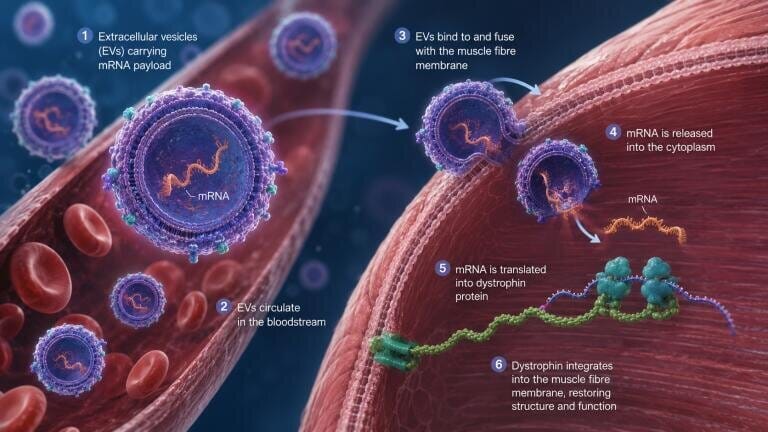
The MD Anderson team used engineered extracellular vesicles (EVs) to deliver the full-length DMD mRNA. EVs are naturally occurring nanoscale particles that cells use to transport biological material. In this study, the researchers modified EVs with targeting tags designed to direct them to skeletal muscle after injection into the bloodstream.
Once delivered, the mRNA-loaded EVs were shown to increase dystrophin protein expression and improve muscle strength and function in preclinical models. The researchers reported that the treatment remained targeted within skeletal muscle and did not trigger the immune responses or toxicities commonly associated with viral-based approaches, even after repeated dosing.
“Our novel platform overcomes the limitations of current viral-based gene therapies, to allow delivery of full-length mRNA, restore wild-type translation of dystrophin and significantly improve muscle function,” Kim said.
“We are highly encouraged by these results, which provide a blueprint for mRNA-loaded EVs as a next-generation therapeutic strategy,” she added.
The technology of mRNA – recognised with the 2023 Nobel Prize in Physiology or Medicine – has attracted substantial interest as a way to instruct cells to produce therapeutic proteins. Since the COVID-19 pandemic it has been widely associated with vaccines against pathogenic infections but mRNA delivery systems have potential applications in cancer, inheritable diseases and regenerative medicine.
The MD Anderson researchers had previously used mRNA-loaded EVs to improve responses to immunotherapy in glioblastoma models which suggests that the technology could have broader use in cancer therapy. Ongoing preclinical work has continued to examine manufacturing methods and the safety profile of EV-based mRNA delivery.
The authors said further studies would be needed before the platform could move towards clinical trials. Key questions include its full safety profile, durability of effect and whether EV-mediated mRNA delivery can reach cardiac muscle, since heart disease is a common and serious feature of advanced DMD.
The findings nevertheless suggest that EV-mediated mRNA delivery could provide a broader platform for protein restoration. If the approach can be translated safely, it may have relevance beyond DMD, particularly for diseases in which large proteins are lost through inherited mutations, acquired damage or degenerative processes.
“Given that we are now able to replace very large proteins, this platform- and disease-agnostic approach could potentially open doors far beyond rare genetic disorders and traditional gene therapy applications,” Kim said.
“It’s possible this could ultimately enable restoration of proteins lost not only through inherited diseases but also from acquired or degenerative processes, including cancer, autoimmune disorders, neurodegeneration, fibrosis and other chronic diseases,” she concluded.
For further reading please visit: 10.1038/s41551-026-01689-5
ILM 51.6 Sept 2026



 Product directory




















,-photo-Karin-Allander.jpg)







.jpg)
