Research news
Scientists have uncovered how cancer-associated mutations can disable an important tumour suppressor protein by disrupting the internal communication system that allows it to function. The study [1], published in Nature Communications, provides new insight into how small molecular changes can affect protein behaviour and contribute to cancer development.
Researchers from the Institute of Biochemical Sciences at National Taiwan University and Academia Sinica investigated BRCA1-associated protein 1 (BAP1), a protein involved in regulating cell growth and frequently mutated in cancers including mesothelioma, uveal melanoma and kidney cancer.
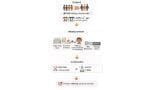
Although many cancer-related BAP1 mutations have been identified, it has remained unclear how these changes interfere with the protein’s activity. To investigate this, the team analysed nearly 50 cancer-associated mutations using advanced nuclear magnetic resonance (NMR) spectroscopy, combined with computational modelling and biochemical experiments.
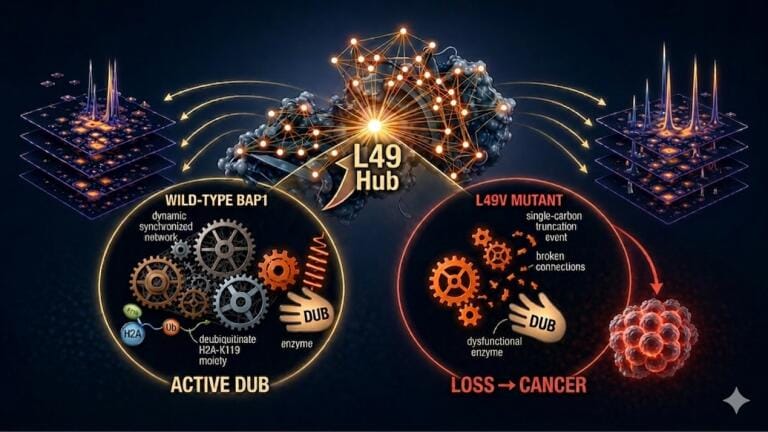
Rather than focusing only on the protein’s overall structure, the researchers examined how different regions of BAP1 move and interact. They discovered a complex internal communication network that enables distant parts of the protein to work together, with a single amino acid, L49, acting as a key signalling hub.
The team found that altering this region by removing just one carbon atom was enough to disrupt the communication network and significantly reduce BAP1 activity, even though the overall protein structure remained largely unchanged.
By mapping the molecular effects of multiple cancer-associated mutations, the researchers created the largest experimental dataset linking BAP1 mutations with changes in protein dynamics. The findings reveal how cancer can arise not only through structural changes, but also through disruptions to the internal movements and communication pathways of proteins.
“Proteins are not static objects — they are constantly moving and communicating internally. Our study shows that even the smallest molecular change can interrupt this communication network and lead to disease,” said Professor Shang-Te Danny Hsu from Academia Sinica Institute of Biological Chemistry and National Taiwan University Institute of Biochemical Sciences.
The researchers believe these findings could support future approaches to precision medicine by identifying new ways to target protein regulation and restore tumour suppressor function, rather than focusing only on traditional active sites.
More information online
1. Allosteric network of dynamic coupling within BAP1-UCH revealed by methyl NMR published in Nature Communications
ILM 51.6 Sept 2026



 Product directory




















,-photo-Karin-Allander.jpg)




.jpg)
