Microscopy & microtechniques
Proteomic analysis of fragmentary bones and teeth has extended the known geographical range of the Denisovans and demonstrated how molecular evidence can reveal the identity of fossils that lack distinctive anatomical features
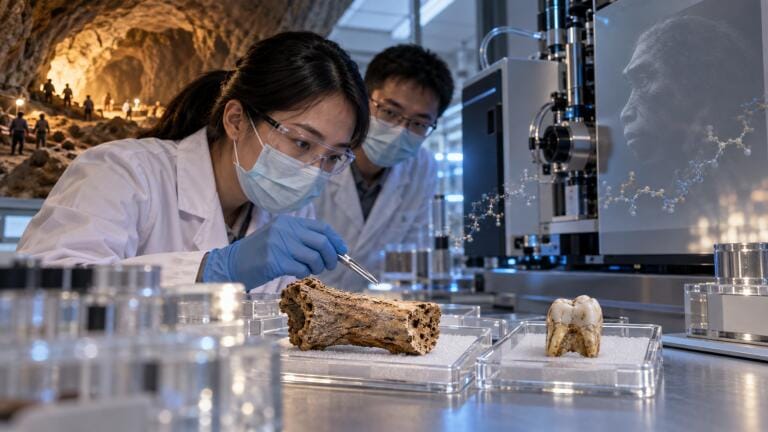
Researchers in China have used ancient proteins to identify Denisovan remains from the country’s southwest, extending the geographical extent in which the ancient human lineage is known to have lived. The team applied proteomic analysis to fragmentary bones and teeth allowing molecular evidence to confirm their biological identity.
The study was led by Huiyun Rao, Song Xing and Qiaomei Fu from the Chinese Academy of Sciences, Beijing, China.
Denisovans are an extinct group of archaic humans closely related to Neanderthals who were first identified in 2010 through DNA extracted from a finger-bone fragment found in Denisova Cave in southern Siberia, Russia, for which the group was named. The cave is around 330 kilometres from the border of modern China but more than 3,000 kilometres from Beijing.
Broken fossils often lack the anatomical features required for confident classification, even when they retain molecules. Analytical chemistry can therefore help researchers to identify specimens that merit examination.
Ancient proteins complement evidence from DNA. Both deteriorate after death, but their preservation depends on different chemical and environmental conditions. Mineralised tissues can protect some protein sequences for long periods, so proteins may survive where genetic material has become too degraded for analysis.
Scientists break proteins into smaller molecules called peptides and measure them through mass spectrometry which separates ionised molecules according to their mass-to-charge ratio. They compare the resulting sequences with reference data. Differences among related groups will then position a specimen within an evolutionary relationship.
The method does not offer the equivalent of a complete fossil genome. Closely related populations share many protein sequences, and a dataset represents only part of an organism’s biological history. Any attribution must therefore rest on the quality and specificity of the molecular evidence, together with its agreement with anatomical, archaeological and chronological observations.
Sampling presents a further challenge because valuable fossils are finite. Molecular extraction may consume irreplaceable material, so researchers should consult curators and specialists before they decide where to sample and how much material to remove.
For further reading please visit: 10.1038/s41586-026-10976-9
ILM 51.6 Sept 2026

 Product directory