Optical imaging
Researchers have developed a transparent graphene-based material that allows soft lenses to change focus electronically, removing the need for the bulky moving parts and opening a route to smaller medical imaging devices and wearable displays
The ability to instantly change focus is something that the human eye makes seem completely effortless, switching between tasks such as reading a book, recognising a face across a room or following a bird in flight. But to replicate that flex in an optical device has proved far more difficult to achieve.
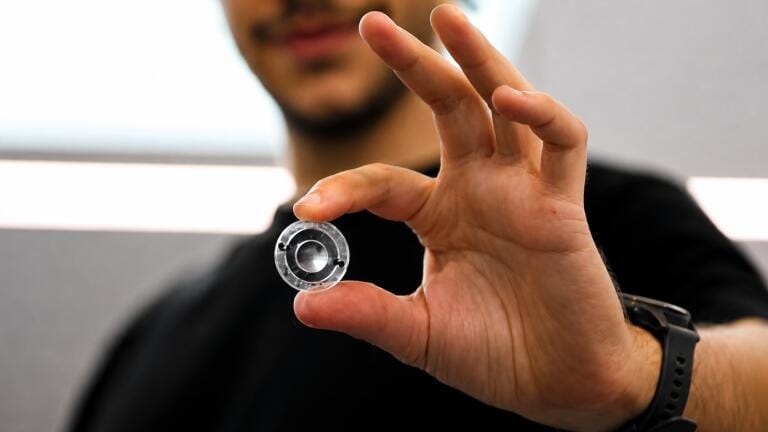
Researchers at Queen Mary University of London, UK, led by Professor James Busfield, have taken an important step towards making adaptive lenses smaller, lighter and more practical. The team has developed a novel transparent graphene-based material that allows soft lenses to change focus electronically, without the need for bulky moving parts. The work has eliminated the key design constraints that have limited electrostatically actuated lenses until now and offers a route to compact medical imaging devices, autofocus cameras and wearable displays.
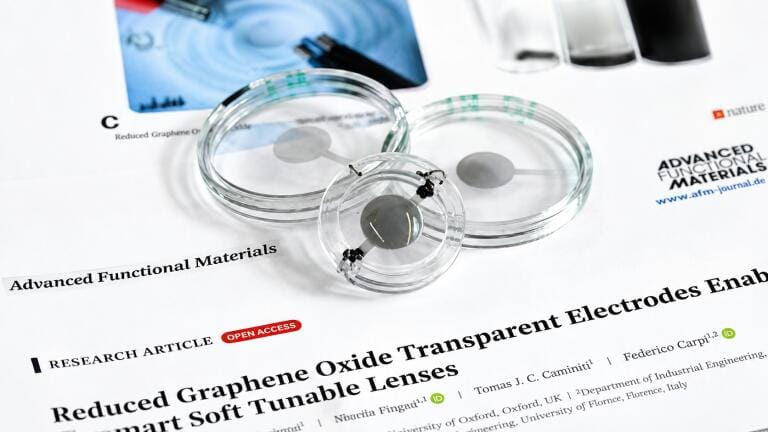
The study demonstrates how ultra-thin transparent electrodes made from reduced graphene oxide can be integrated into a soft, electrically driven lens. The result is a compact device that changes its focal distance simply by the introduction of a small electrical field.
Unlike the rigid lenses found in conventional cameras, microscopes and other optical instruments, the prototype behaves more like a living eye. When electricity is applied, a soft membrane stretches the lens gently. This subtly alters its shape and brings objects at different distances into focus.
This is in direct contrast to the functionality of conventional electrostatically actuated adaptive lenses which position their electrodes around the edge of the lens because the materials used block light. Moreover, traditional electrically driven soft lenses require flexible electrodes to move the lens but these electrodes are often opaque which makes them unsuitable for optical applications.
By engineering transparent electrodes from reduced graphene oxide, the research team was able to integrate them directly onto the expanding actuator beneath the lens itself. This novel architecture has dramatically reduced the device’s size and complexity, and it allows the lens to change focus electronically.
By carefully controlling the amount of graphene deposited onto the soft membrane, the researchers identified an effective balance between electrical performance and optical clarity that was needed to create a functioning adaptive lens. Their prototype adjusted its focus across a range of distances while maintaining a compact design.
Although still at the research stage, the technology could open the door to a novel generation of adaptive optical devices that are thinner, quieter and more energy efficient than existing systems.
“This is exciting … in the future, similar technology could find applications in autofocus cameras, wearable displays, virtual and augmented reality headsets, miniature medical imaging devices and scientific instruments where conventional mechanical focusing systems add weight, complexity or cost,” said Dr. Giacomo Sasso, first author of the study.
The research has also highlighted the growing potential of soft robotics and advanced materials to transform everyday technologies.
“Instead of relying on motors and gears, electrically active polymers behave more like artificial muscles, changing shape smoothly and silently in response to electrical signals.
“Coupled with graphene’s exceptional electrical properties, they offer engineers an entirely new approach to designing optical systems,” added graduate student Alec Lamoreux, who was second author of the study.
While further work is needed to improve the transparency of the graphene electrodes and to optimise their performance, the findings demonstrate that soft, electrically tunable lenses can be built using simple manufacturing techniques and inexpensive materials.
For further reading please visit: 10.1002/adfm.76426
ILM 51.6 Sept 2026



 Product directory























.jpg)
