News
A survey of 13 drinking-water sources in China found higher resistance-gene risks at river sites, while Poyang Lake also showed elevated risk in summer
A study of drinking-water sources in China’s Poyang Lake basin found that river sites generally had higher antibiotic-resistance gene risks than enclosed reservoirs. Poyang Lake, an open and shallow lake, also showed elevated risk in summer. The findings point to locations for targeted monitoring but do not demonstrate exposure through treated drinking water.
The basin supplies drinking-water sources for about 45 million people. Researchers sampled eight river sources and five sites classified as reservoir-type in December 2024 and June 2025. The latter group included Poyang Lake as well as four enclosed reservoirs. They tested for 46 antibiotics, measured eight resistance genes and an integrase gene, and assessed antibiotic susceptibility in 178 cultured bacterial isolates.
Thirteen antibiotics were detected. Florfenicol and sulfamethoxazole reached maximum concentrations of 72.85 and 30.51 nanograms per litre, respectively. Analysis pointed to livestock farming, domestic sewage and aquaculture as possible pollution sources. Some sites on the Gan River had moderate or high ecological risks from ciprofloxacin, norfloxacin and erythromycin.
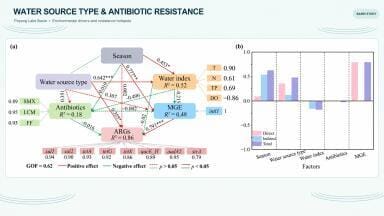
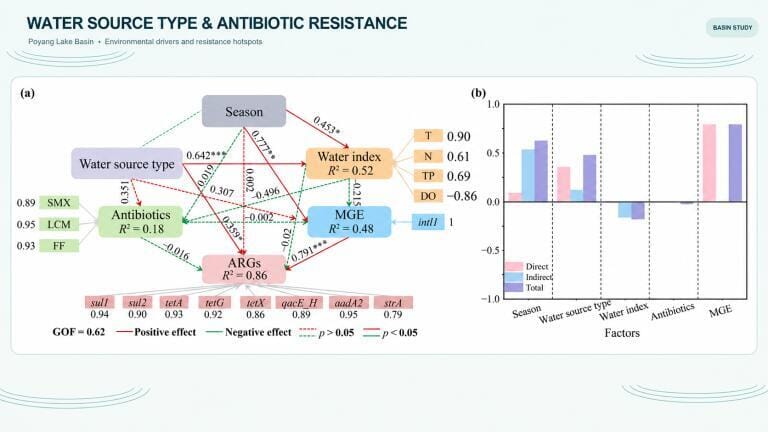
Resistance genes were more abundant in summer, with sulphonamide resistance genes most common. Mobile genetic elements, which can help genes move between bacteria, were the strongest direct correlate of resistance-gene abundance in the study’s statistical model. River isolates more often resisted lincomycin and penicillin than reservoir isolates, although the overall difference in multiple-antibiotic resistance index was not statistically significant. Carrying a resistance gene did not always correspond to resistance in laboratory tests.
The authors recommend that monitoring consider antibiotic residues, resistance genes and bacterial susceptibility together, with attention to river sources, the Gan River sub-basin and Poyang Lake. Repeated sampling and broader genetic analysis could refine these priorities.
The researchers sampled during winter low-flow and summer high-flow conditions. They used ultra-performance liquid chromatography coupled with tandem mass spectrometry to measure antibiotics and quantitative polymerase chain reaction to quantify resistance genes. The cultured isolates were tested for susceptibility to antibiotics. Bringing chemical, genetic and bacterial data together allowed the team to compare different indicators of resistance risk.
Resistance-gene abundance increased in summer, and sulphonamide resistance genes dominated, at roughly 6,300 to 16 million copies per litre. River sources generally had higher gene-related risk scores, while the Poyang Lake site also stood out in summer. The statistical model associated season with resistance-gene abundance mainly through mobile genetic elements, which can help genetic material move between bacteria.
Among the 178 bacterial isolates, resistance was most frequent to lincomycin, at 75.84 per cent, and penicillin, at 53.95 per cent. River isolates showed significantly higher resistance to those two medicines. However, the average multiple-antibiotic resistance index was low in both seasons, and the overall index did not differ significantly between river and reservoir groups.
The study examined source water, not water after treatment or people’s exposure. Its results identified environmental patterns that may merit monitoring and pollution prevention; they did not show that antibiotic-resistant bacteria caused infections in consumers.
Ecological risk assessments identified certain sites on the Gan River as locations where ciprofloxacin, norfloxacin or erythromycin could pose moderate or high risks to aquatic organisms. The team used source-apportionment analysis to identify livestock farming, domestic sewage and aquaculture as likely contributors to contamination, although these analyses indicate probable sources rather than proving a specific discharge route.
The distinction between source-water findings and drinking-water exposure is important. The study did not test water after treatment or measure health effects in people. Instead, it provides a basis for water managers to prioritise monitoring locations and potential pollution controls before water enters treatment systems.
For further reading please visit: 10.48130/biocontam-0026-0010
ILM 51.6 Sept 2026
 Product directory