News
A structured X-ray beam and computational reconstruction produced 3D elemental maps 43 times faster than conventional approaches, using more than 97 per cent fewer measurements
Researchers have developed an X-ray fluorescence method that mapped 3D chemical structures 43 times faster than conventional approaches while using more than 97 per cent fewer measurements. The technique could help scientists study complex samples where measurement time is limited.
X-ray fluorescence imaging reveals which chemical elements are present in a sample and where they occur. A conventional 3D map usually requires a point-by-point scan, which can take time and produce large datasets.
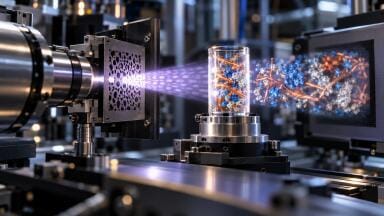
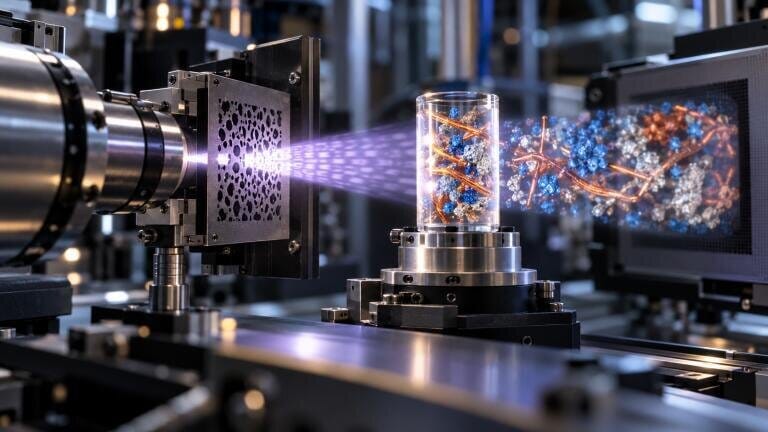
The team at Bar-Ilan University, Tel Aviv, Israel, and collaborating institutions placed a randomly patterned tungsten mask in the X-ray beam. This created a structured pattern that encoded information from several parts of the sample at once. As the researchers rotated a sample containing copper, zirconium and silver, they measured fluorescent X-rays emitted by the elements. An algorithm reconstructed the 3D distribution from the compressed measurements.
The researchers used the method to locate microscopic metal wires and particles while omitting more than 97 per cent of the measurements normally required. It extends their earlier two-dimensional work on X-ray fluorescence ghost imaging.
“By designing the X-ray illumination together with the computational reconstruction, we can recover detailed 3D chemical information from a remarkably small number of measurements,” said Dr. Sharon Shwartz at Bar-Ilan.
The team said faster scans could make better use of limited access to synchrotron facilities and help researchers follow chemical processes or study delicate samples with less exposure to X-rays. The method has so far been tested on metal structures. The researchers plan to assess it with more complex biological and geological samples and to explore artificial-intelligence methods that could improve speed and resolution.
Adi Ben-Yehuda, a doctoral candidate in Shwartz’s laboratory at Bar-Ilan, said the method recovered detailed information from a small number of measurements by combining structured illumination with computational reconstruction. The work was carried out with Dr. Alexander Rack of the European Synchrotron Radiation Facility (ESRF) and Dr. Nicola Viganò of Université Grenoble Alpes.
The approach could be useful at synchrotron facilities, where access to intense X-ray sources is limited and researchers need to make efficient use of beam time. Faster measurement may also allow larger samples to be scanned, chemical changes to be followed as they occur, or radiation-sensitive materials to be studied with a lower X-ray exposure.
The researchers plan to test the method on more complex biological and geological samples. They also intend to explore whether artificial intelligence and deep learning can improve reconstruction speed and resolution. The work was supported by the Israel Science Foundation and the ESRF.
Traditional point-by-point scanning records fluorescence from one location at a time. The tungsten mask instead creates a known random pattern, allowing the detector to collect mixed information from across the rotating sample. The reconstruction algorithm uses the pattern and the measurements together to infer where each element is located. The team demonstrated the approach with microscopic metal structures, including wires and particles.
The reported speed comparison and data reduction relate to the conventional measurements required for this type of reconstruction. The researchers said their design changes the balance between information and measurement time, but assessment on a wider range of samples will be important before its practical limits are known.
For further reading please visit: 10.1364/OPTICA.601674
ILM 51.6 Sept 2026
 Product directory