News
Archival research indicates Rosalind Franklin used Photo 49 to calculate features of DNA before making a cleaner image, the famous Photo 51, in 1952
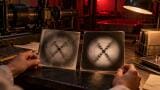
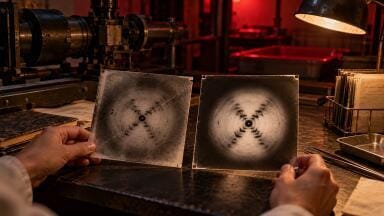
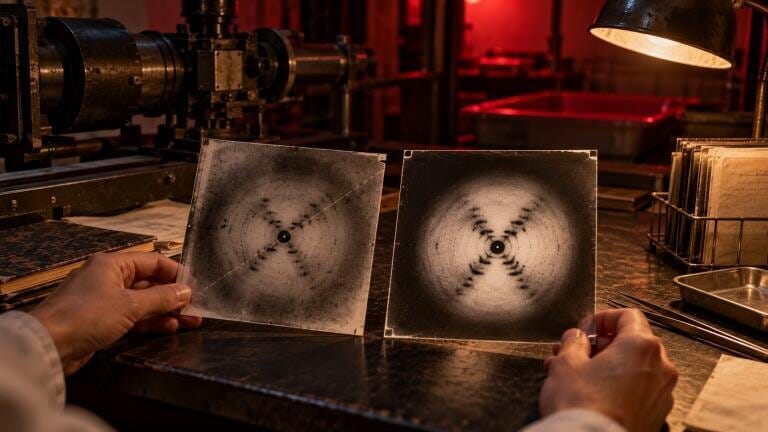
Dr. Rosalind Franklin had used an earlier X-ray photograph – Photo 49 – to calculate key features of the helical structure of DNA before she and Raymond Gosling produced the better-known Photo 51, according to recent archival research. The findings challenge accounts that Franklin failed to recognise the significance of Photo 51.
Photo 49 contained a blemish caused by a part of the X-ray camera slipping across the film. Despite the flaw, Franklin extracted structural information from the image. The researchers said she had not yet established whether DNA consisted of one, two or three strands, but understood that its X-ray diffraction pattern could reveal features of its helical structure.
Franklin and her graduate student Gosling made Photo 51 at King’s College London, UK, in 1952 by recording how X-rays scattered from DNA. The resulting X-shaped pattern provided evidence of a helix. In early 1953, the image was shown to Dr. James Watson without Franklin’s knowledge. Watson and Dr. Francis Crick later published their double-helix model alongside a paper by Franklin and Gosling describing the photograph.
This study’s authors examined notebooks, manuscripts, photographs and other records in collections in Philadelphia, USA, as well as Cambridge and London. They also studied Franklin’s original X-ray camera and the photographic slides she produced. Dr. Alistair Sponsel of the Science History Institute and Dr. Brian Sutton of King’s College London concluded that Photo 51 was a planned, higher-quality repeat of Photo 49.
The researchers said the findings do not diminish Watson and Crick’s work but provide a fuller account of Franklin’s contribution. They also show how laboratory records and technical details can help historians reassess how scientific discoveries were made.
The historical question centres on what Franklin knew when she and Gosling made the later photograph. Some accounts treated Photo 51 as the moment when the helical nature of DNA became apparent to others, while suggesting that Franklin did not recognise its importance. The researchers argued that Photo 49 changed that interpretation indicating its pattern had already allowed Franklin to calculate structural features, despite the mark across the image.
The archival work began after the Science History Institute acquired the History of Molecular Biology Collection from the J. Craig Venter Institute in 2025. The collection contains Franklin’s own copy of Photo 51, as well as notebooks, correspondence and photographs. Sponsel’s research led him to King’s College London, where Franklin and Gosling conducted their experiments, and to a collaboration with Sutton, who had studied the institution’s earlier X-ray crystallographic work.
The researchers also examined Franklin’s camera and original slides. The camera’s internal component had moved across the film during the making of Photo 49, obscuring part of the pattern. By studying how the equipment and photographic process worked, the team concluded that Photo 51 was a deliberately improved repeat rather than the first image from which Franklin learned that DNA was helical.
The account does not change the fact that Watson and Crick developed the double-helix model. It adds evidence about the experimental work that preceded it and about Franklin’s own understanding. The authors said original records were essential when historians assess not only what a scientific image showed, but why researchers made it and how they interpreted it.
Co-author Sutton said he and Sponsel approached Photo 51 from different perspectives and used the archival material to understand why Franklin and Gosling made it, as well as the significance of Photo 49. Dr. Alexandra Eveleigh, head of archives at King’s College London, said the institution’s records allow researchers to revisit established accounts and clarify how major discoveries were made.
The study does not claim that Franklin had resolved every detail of DNA’s structure from Photo 49. Rather, it indicates that she had already extracted key information about its helical form and then planned a clearer exposure. Watson later wrote that seeing Photo 51 helped him and Crick develop their model, while Franklin and Gosling published their account of the photograph in the same issue of Nature as the model papers.
ILM 51.6 Sept 2026

 Product directory