Clinical, medical and diagnostics
A study of more than 12,000 pregnancies found that adding routine laboratory markers to a clinical screening model improved prediction of preterm and term pre-eclampsia
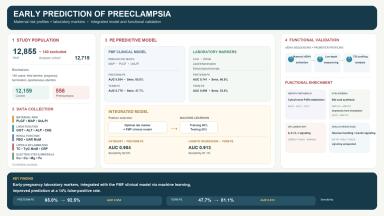
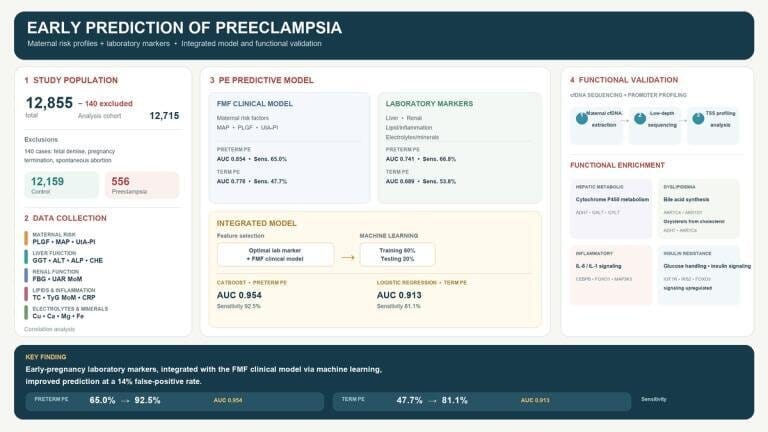
Routine laboratory results improved a first-trimester model for predicting pre-eclampsia when combined with clinical risk factors reported researchers from an international collaboration by the First Affiliated Hospital of Soochow University, Suzhou, Jiangsu, China and the University of Chicago Medical Center, Chicago, Illinois, USA. The analysis included 12,715 pregnancies, of which 556 developed pre-eclampsia, and the authors said the findings need further assessment before clinical use.
Pre-eclampsia is a pregnancy complication involving high blood pressure and effects on multiple organs after 20 weeks of gestation. Early identification can support preventive care but established first-trimester screening models have only moderate sensitivity. The research team assessed whether common laboratory measures could add useful information.
The researchers identified 26 laboratory indicators that differed between pregnancies that later developed pre-eclampsia and uncomplicated pregnancies. These covered liver and kidney function, lipid metabolism, inflammation, electrolytes and insulin resistance. Several markers had nonlinear associations with risk, suggesting that the relationship was not captured by a simple increase or decrease across their full ranges.
Machine-learning models were developed for preterm and term disease. When laboratory markers were combined with the Foetal Medicine Foundation screening approach, the area under the receiver operating characteristic curve reached 0.954 for preterm pre-eclampsia and 0.913 for term disease. The study also examined cell-free DNA from 51 maternal plasma samples and found early molecular patterns linked to inflammation, oxidative stress, metabolic changes and placental blood-vessel development.
The results suggested that routinely collected information may help refine risk estimates. They do not show that the model can improve outcomes in clinical practice. The authors said further validation will be needed to assess how well it performs in other populations and whether using it can guide effective preventive care.
The pregnancy records included maternal characteristics and clinical information, such as age, body mass index, plurality, parity and in-vitro fertilisation, as well as ultrasound and laboratory measures collected before 14 weeks of gestation. The modelling separated preterm and term pre-eclampsia and compared several algorithms. AdaBoost performed best for preterm disease, while logistic regression performed best for term disease.
The integrated models combined the best-performing laboratory marker model with the Fetal Medicine Foundation approach, which includes maternal risk factors, mean arterial pressure, placental growth factor and uterine artery pulsatility index. The reported areas under the curve were 0.954 for preterm disease and 0.913 for term disease. The researchers also reported higher detection at the same false-positive threshold than with the clinical model alone. These measures describe the study’s predictive performance and do not establish that screening improves health outcomes.
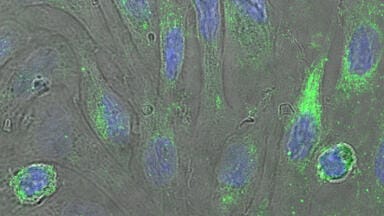
To explore possible biological changes, the team sequenced cell-free DNA and examined transcription start-site profiles in plasma from 51 participants, including 18 with preterm pre-eclampsia and 33 controls. The profiles were associated with immune dysregulation, oxidative stress, metabolic dysfunction and placental angiogenesis. The authors interpreted these findings as evidence that systemic changes may precede symptoms, while noting that larger studies must test how the markers perform in other settings.
The analysis also explored threshold effects in individual tests. Gamma-glutamyltransferase, alkaline phosphatase, the triglyceride-glucose index, C-reactive protein, magnesium, iron and high-density lipoprotein cholesterol showed nonlinear relationships with later pre-eclampsia. The models identified inflammatory and metabolic measures, including the uric acid-to-albumin ratio, prealbumin and C-reactive protein, among features that contributed to prediction.
The study therefore offers both a prediction analysis and an investigation of possible mechanisms. Its large pregnancy dataset supports further validation, but a model developed from one study population may not transfer directly to other health systems.
For further reading please visit: 10.1016/j.gendis.2026.102075
LMUK 51.7 Nov 2026

 Product directory