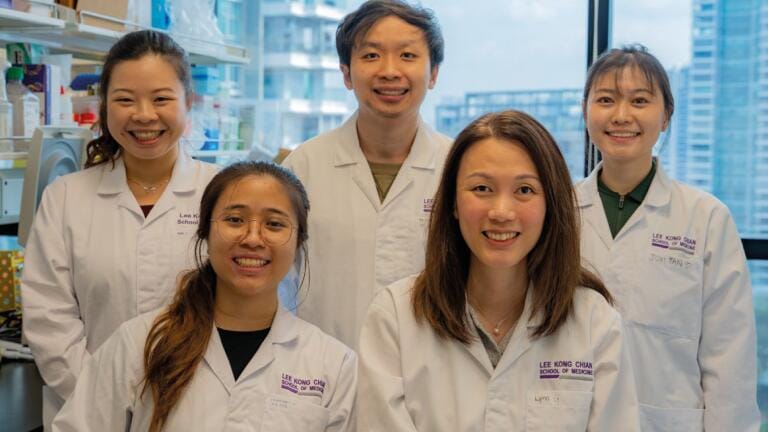
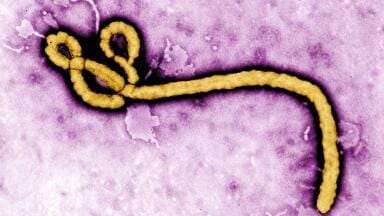
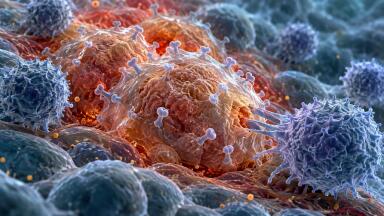
![[From left] Fig1. The scientists transplanted CVPs (above) into pig hearts and tracked the genes expressed by the cells as they matured into heart muscle cells. Credit: LKCMedicine. Fig2. To detect gene activity after stem cell transplantation, a section of pig heart is placed on a slide containing probes that bind to RNA molecules produced by genes in the stem cells. In this molecular heat map, each coloured dot represents a small patch of tissue approximately 55 micrometres across. The colour indicates how actively the gene is being expressed – red dots signal high activity; blue dots signal low activity. Credit: LKCMedicine](/assets/file_store/pr_files/68530/thumbnails/images/768w-432h-t-fit-stem-cells-midkine-heart-attack-repair-two-up.jpg)
Research news
Researchers at Nanyang Technological University, Singapore, have mapped how transplanted cardiovascular progenitor cells mature inside damaged hearts and have identified the protein Midkine as a potential means to promote blood-vessel repair
A research team at Nanyang Technological University, Singapore, has mapped how transplanted cardiovascular progenitor cells mature inside damaged hearts and have identified the protein Midkine as a potential means to promote blood-vessel repair.
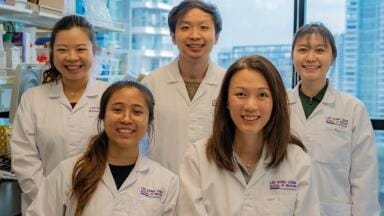
Led by Assistant Professor Lynn Yap of the Lee Kong Chian School of Medicine at Nanyang Technological University, Singapore, the team uncovered important insights into how unspecialised stem cells develop and mature into heart muscle cells. The findings could help to advance stem-cell-based treatments for heart disease.
The scientists also found that a protein called Midkine can help to repair damaged blood vessels. The protein could therefore improve recovery after a heart attack and maintain the organ’s ability to pump blood.
Heart disease remains one of the leading causes of death worldwide and contributes to approximately one-third of global deaths. A heart attack occurs when a blockage in a coronary artery restricts the supply of oxygen and nutrients to part of the heart muscle. With its blood supply impaired the heart muscle cells – cardiomyocytes – are damaged and can die.
Unlike other tissues, adult heart muscle has very little capacity to replace cells which are lost in a heart attack. Instead, the body produces scar tissue to reinforce the injured area. Although this response helps to maintain the structural integrity of the heart, scar tissue does not contract effectively like healthy heart muscle. The heart consequently may weaken over time which itself increases the risk of developing other cardiac conditions.
Stem cells – sometimes described as ‘master cells’ because they can develop into specialised cell types – may have the capacity to be engineered to replace damaged tissue and restore organ function.
One promising cell type is the human pluripotent stem cell-derived cardiovascular progenitor cell (CVP). These progenitor cells represent an intermediate stage between pluripotent stem cells and the specialised cells of the cardiovascular system. They can develop into several of the cell types that make up the heart making them potential strong candidates for therapies designed to regenerate damaged heart muscle.
To examine how these cells developed after transplantation, the researchers induced heart attacks in pigs and introduced CVPs into the animals’ hearts. Pig hearts resemble human hearts in several important anatomical and physiological respects, so they can provide a valuable model through which to assess potential cardiac treatments.
The research team analysed gene expression in the transplanted cells at several points after treatment. Gene expression is the process by which cells use instructions encoded in their genes to produce functional molecules, including proteins. Changes in this activity can reveal how cells respond to their surroundings and acquire specialised functions.
The scientists used a technique called spatial transcriptomics to conduct the analysis. Conventional approaches can measure gene activity in tissue but may lose information about the precise location of each cell. By contrast, spatial transcriptomics measures the activity of thousands of genes while preserving data about where that activity occurred within a tissue sample.
The technique detects RNA molecules which cells produce when genes become active, at thousands of microscopic locations. Each location acts as a small sensor. Together, these sensors create a detailed map that shows which genes are active and where they are active within the heart.
After transplantation, CVPs activate genes associated with metabolism, energy production, protein synthesis and heart muscle contraction. These changes indicated that the cells had begun to take on the characteristics required for functional heart tissue.
At the same time, the researchers detected lower activity among genes associated with the formation of scar tissue. This result indicated that the transplanted cells had integrated into the damaged heart and could support tissue repair while reducing the excessive accumulation of scar tissue.
The restoration of blood supply is essential following a heart attack. Heart tissue requires an extensive network of blood vessels to deliver oxygen and nutrients, remove waste products and sustain the high energy demands of contraction for the pumping for circulatory blood supply. Regenerated muscle cannot survive or function properly unless blood vessels support it.
The researchers identified Midkine as one of the factors produced by the transplanted stem cells. A protein, Midkine is a growth factor which helps to regulate processes such as cell growth, movement, survival and tissue repair. The protein also promotes the development of blood vessels, a process that could improve the supply of oxygen and nutrients to injured heart tissue.
First discovered Midkine in 1988, its role in the heart’s response to injury has remained uncertain. This study has provided evidence that the protein contributes to cardiac repair through its effects on vascular tissue.
In laboratory experiments, the researchers increased Midkine production and found that this enhanced the capacity of endothelial cells to migrate and form blood vessels. Endothelial cells line the interior surface of blood vessels and provide the cellular foundation from which vascular networks develop.
The team also engineered stem cells to produce higher levels of Midkine. When tested in mice, these modified cells stimulated greater blood-vessel formation, providing additional evidence that Midkine could support the repair of cardiac tissue.
“Our study provides an unprecedented understanding of how stem cells interact with the damaged heart to regenerate heart muscle which may accelerate the development of novel stem-cell-based therapies to treat heart disease,” said Assistant Professor Lynn Yap.
“The findings also show that Midkine is crucial for recovery after heart disease and help to resolve a decades-old debate about the role of Midkine in heart repair,” she added.
The researchers have created a freely accessible web application through which other scientists can search and examine the study’s gene-expression data: human-pig myocardial infarction hearts spatial transcriptomics resource.
The team now plans to investigate the biological mechanisms through which Midkine supports blood-vessel growth and heart repair. A clearer understanding of these processes could help researchers to determine whether the protein can be harnessed safely and effectively as a treatment for heart disease.
For further reading please visit: 10.1038/s44161-026-00851-1
ILM 51.6 Sept 2026



 Product directory












,-photo-Karin-Allander.jpg)