Clinical, medical and diagnostics
Researchers have developed a rapid and highly sensitive laboratory test that uses magnetic nanoparticles to detect allergy to beta-lactam antibiotics. The technology could help clinicians to remove incorrect penicillin allergy labels and reduce reliance on less effective or more toxic alternative treatments.
A multidisciplinary scientific team at the University of Málaga, Andalusia, Spain, has developed a novel diagnostic technology that uses magnetic nanoparticles to identify allergies to beta-lactam antibiotics – including amoxicillin and other penicillins – with precision, speed and reliability.
The highly efficient in vitro platform uses nanoparticles that measure 30 nanometres in diameter. Each particle consists of an iron oxide core surrounded by a silica shell and acts ‘like a tiny magnet covered with thousands of molecular hooks’.
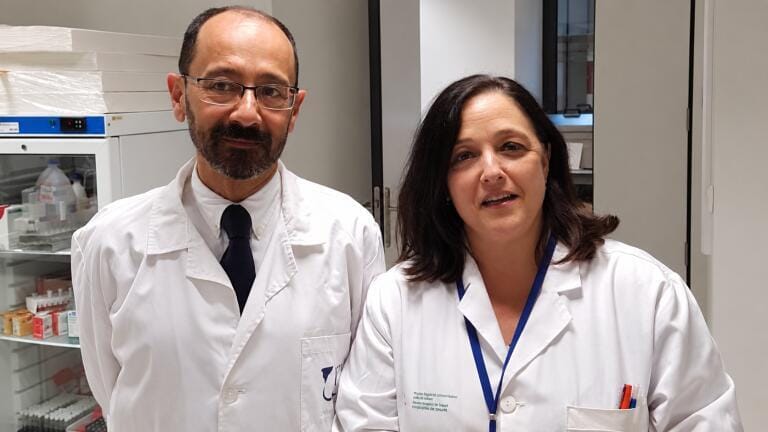
“If the patient’s blood contains the immunoglobulin E antibodies responsible for the allergy, the nanoparticles capture them much more readily than conventional methods do,” explained Dr. Ezequiel Pérez-Inestrosa, professor of organic chemistry at the University of Málaga and one of the study’s authors.
Immunoglobulin E (IgE) is an antibody that forms part of the immune system. In people with an immediate drug allergy, IgE can recognise a particular medicine, or a substance derived from it, and triggers an allergic reaction. The ability to detect drug-specific IgE accurately is therefore an important part of laboratory diagnosis.
The research also involved scientists from the Biomedical Research Institute of Málaga and Nanomedicine Platform (IBIMA Plataforma BIONAND) the Inflammatory Diseases Network and the Regional University Hospital of Málaga.
Dr. Yolanda Vida and Dr. María I Montañez, researchers in the University of Málaga’s department of organic chemistry, were the study’s lead authors.
“In the tests performed, the system detected virtually all genuine cases of allergy and reduced the number of both false-negative and false-positive results,” said Dr. María José Torres, professor of medicine and another of the researchers who led the study.
The researchers noted that penicillin allergy was frequently overdiagnosed. Although between eight and 25 per cent of the population reported an allergy to these antibiotics, only between one and 10 per cent were found to have a genuine allergy.
An incorrect allergy label can lead clinicians to prescribe alternative antibiotics that can be either less effective or more toxic and their incorrect use can also contribute to antimicrobial resistance.
“It is important to identify these cases safely because this could allow clinicians to remove thousands of incorrect diagnoses that affect patients’ treatment,” explained Pérez-Inestrosa.
The novel method could also reduce the need for drug provocation tests, in which a patient receives carefully controlled doses of the suspected medicine under medical supervision. Although these tests can provide a definitive diagnosis, they expose the patient to the drug and therefore carry a risk of an allergic reaction.
By contrast, the nanoparticle test can be conducted on a blood sample in the laboratory. The method is also simpler and faster than existing approaches because it does not require lengthy centrifugation procedures.
For the study, the researchers analysed blood samples from 94 people. This group comprised 50 patients with a confirmed allergy to amoxicillin and 44 people who could tolerate the antibiotic.
The team compared the nanoparticle platform with two established diagnostic methods:
For amoxicillin allergy, the platform achieved a sensitivity of 98 per cent. This meant that it correctly identified 98 per cent of the participants who had the allergy. ImmunoCAP, by comparison, detected approximately 17 per cent of confirmed cases in the study.
High sensitivity is particularly important in allergy diagnosis because a false-negative result could incorrectly indicate that a patient was able to tolerate a medicine. The reported reduction in false-positive results could also help to prevent people without a genuine allergy from retaining an unnecessary diagnostic label.
The results indicated that the technology could support more accurate antibiotic-allergy assessment and help clinicians to select the most appropriate treatment. However, the authors emphasised that larger multicentre studies and further clinical validation would be necessary before the platform could be introduced into hospitals for routine use.
For further reading please visit: 10.1016/j.mtbio.2026.103356
ILM 51.6 Sept 2026


 Product directory


.jpg)