Detectors
Exceptionally bright dye-sensitised nanoparticles could help manufacturers detect pharmaceutical impurities and identify trace pollutants in groundwater
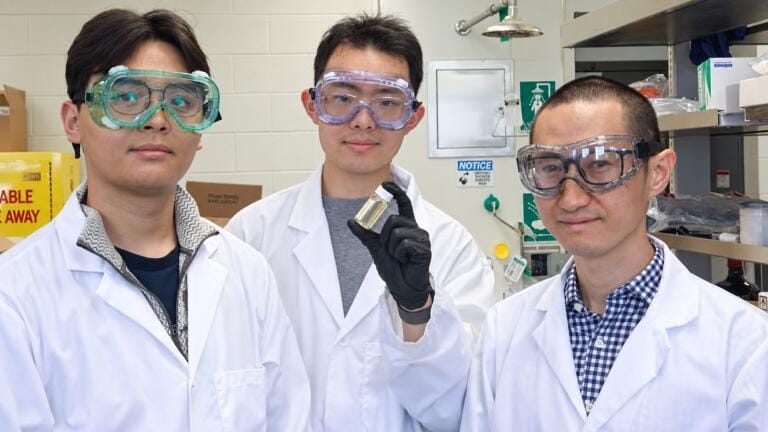
A research team led from the Faculty of Applied Science and Engineering at University of Toronto, Canada, has created dye-sensitised nanoparticles that can detect chemicals at exceptionally low concentrations and distinguish between molecules with almost identical structures.
The technology could provide a more accessible way to identify pharmaceutical impurities or trace pollutants in groundwater. When the particles bind to a target molecule, they absorb low-energy photons and emit a higher-energy photon through a process known as ‘upconversion’.
“Organic molecules called fluorophores have been used for decades to absorb light and convert it into colourful emissions but the process normally works in only one direction,” said Professor Kai Huang, the study’s senior author.
“With conventional fluorophores, the excitation frequency must be higher than the emission frequency,” Huang explained.
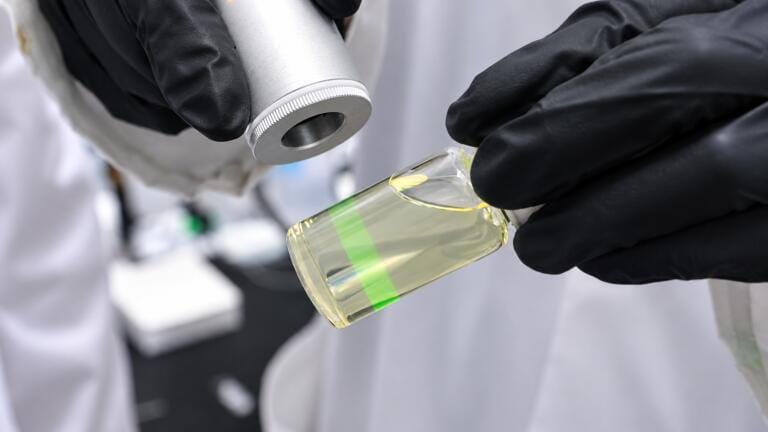
“Our nanoparticles can instead absorb low-energy photons and emit higher-energy photons. Near-infrared light from a low-cost laser, for example, causes them to glow bright green,” he added.
The difference between the excitation and emission frequencies helps researchers distinguish the desired signal from background interference. Biological and chemical samples often produce their own fluorescence when exposed to light, which can conceal weak signals from sensing agents.
“It is like the difference between observing stars at night and during the day. The stars remain just as bright, but sunlight overwhelms them.
“To use a lower excitation frequency virtually eliminates the autofluorescent background while the nanoprobes continue to shine,” Huang said.
Ions of ytterbium and erbium – which belong to the lanthanide family of elements – make upconversion possible. In conventional particles, exterior dye molecules absorb infrared light and transfer its energy to ytterbium ions. These ions act as a relay and pass the energy to erbium ions which emit green light.
Dense concentrations of ytterbium can nevertheless recapture energy that the erbium should emit, a process known as back-energy transfer.
“The energy that should appear as green light instead returns to the ytterbium relay and never reaches the particle’s surface,” said Jiaze Wu, a doctoral candidate in Huang’s laboratory and the paper’s lead author.
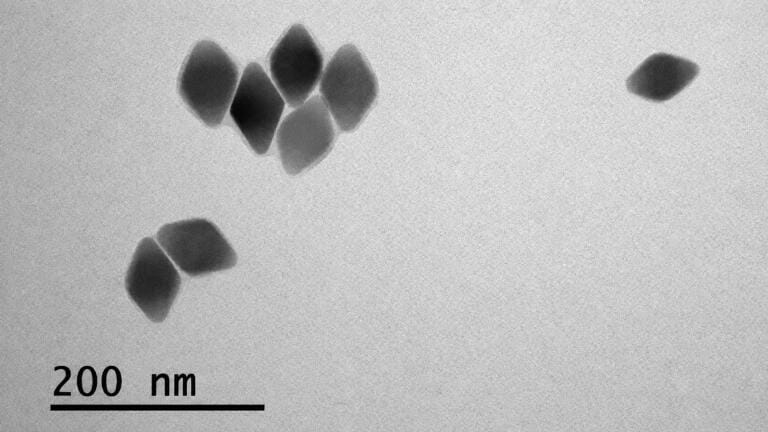
The researchers addressed this limitation with a host matrix composed of lithium, lutetium and fluorine. They also replaced the conventional flat, hexagonal particle with a three-dimensional, diamond-like structure formed from a dense core and two surrounding shells.
“We created a controlled gradient in which the concentration of ytterbium increased through each layer, with the highest concentration in the core,” Wu said.
“Almost all the incoming light energy therefore travelled in one direction, towards the erbium ions,” he said.
Monte Carlo simulations and density functional theory allowed the team to assess dozens of formulations and geometries before it manufactured the particles. A Monte Carlo simulation is a computer method that uses repeated random sampling to estimate how a complex system is likely to behave.
“The analysis showed that the core-shell-shell structure could function as a one-directional energy tunnel for incoming light,” said Weixiang Ben, an undergraduate researcher who led the computational work.
The particles emitted about 150 times more light than upconversion nanoparticles without dye sensitisation and about 50 times more than some highly optimised conventional structures under the same excitation conditions.
Their sensitivity also allowed them to distinguish between structural isomers which contain the same atoms in slightly different arrangements. This capacity could help pharmaceutical manufacturers detect unwanted isomers that might reduce a medicine’s effectiveness or cause harmful side effects.
“With these nanoparticles manufacturers could detect impurities with low-cost lasers and a very small sample,” Wu said.
The researchers must now devise a reliable method to manufacture the nanoparticles at scale.
“We believe that mass production is feasible, although it will require a lengthy development programme. For now, the work provides proof that high-performance upconversion nanoparticles could be customised to detect almost any target molecule,” Huang said.
For further reading please visit: 10.1021/jacs.6c07018
ILM 51.6 Sept 2026


 Product directory


.jpg)























.jpg)