Mass spectrometry & spectroscopy
A novel workflow has quantified more than 50 proteins in individual bacteria and detected stress-associated differences that bulk measurements could conceal
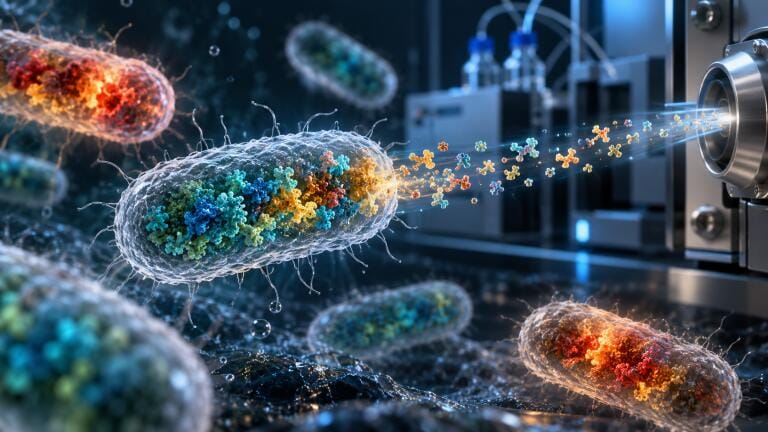
Researchers have extended mass-spectrometry-based single-cell proteomics to individual bacteria through a workflow that addresses the extremely small quantities of protein available from each cell. The method, named bacterial single-cell proteomics (bacSCP) quantified more than 50 proteins from individual Bacillus subtilis and Escherichia coli cells.
The study also detected a reproducible heat-stress response and evidence of variation within the stressed population. It has provided a proof of concept for direct protein measurements at a scale where cell disruption, sample loss and contamination can each determine whether a useful biological signal survives.
Proteomics examines the proteins present in a biological sample and – where possible – their relative or absolute abundance. Bulk analysis combines material from many cells, which usually improves analytical sensitivity but produces a population-level result. If a minority of cells responds differently to stress, that response may become difficult to distinguish from the dominant pattern after all the material has been combined.
Individual-cell measurements offer a way to investigate this variation directly. However, a bacterium presents a more demanding sample than many mammalian cells because its total protein content is much smaller. The cell envelope also complicates access to the material inside. A workflow must release proteins efficiently while avoiding the losses and contamination that become disproportionately important at such low input.
The researchers used liquid chromatography coupled with tandem mass spectrometry to analyse the prepared material. Liquid chromatography separates sample components before mass-spectrometric analysis. Tandem mass spectrometry then generates additional information through fragmentation, which helps identify peptides and connect them with their parent proteins. Successful separation and identification depend on the quality of the material that reaches the instrument.
At the single-bacterium scale, preparation is therefore inseparable from instrument performance. Material can adhere to container surfaces, disappear during transfers or become diluted below a useful concentration. A small amount of external protein may also rival the signal from the cell itself. These effects require careful controls because an apparent biological difference can otherwise originate in the analytical workflow.
The reported quantification of more than 50 proteins established that the platform could recover interpretable information from individual cells of both bacterial species. This does not amount to a comprehensive bacterial proteome. Many proteins remained outside the observed set, particularly those whose abundance or analytical behaviour made them less accessible under the method’s conditions.
The heat-stress experiment supplied a biological test beyond the number of detected proteins. The researchers reproducibly observed increases of as much as eight-fold in chaperones that help cells manage protein stress. The highlighted response involved a Bacillus subtilis strain in which the mcsB gene had been deleted. That genetic context should be retained when the result is compared with an unmodified bacterial population.
Chaperones support protein quality control, so an increase after heat exposure is biologically plausible. Its detection helped show that the measured signals reflected an organised cellular response rather than an arbitrary collection of protein identifications. Nevertheless, the eight-fold value describes the largest reported changes in the tested system and should not be viewed as a uniform increase across every protein or cell.
The single-cell data also indicated potential heterogeneity within the heat-stressed subpopulation. This is the aspect most relevant to questions about how apparently similar bacteria respond differently to their environment. A bulk measurement might show an average increase while failing to reveal whether most cells changed moderately or a smaller group changed much more strongly.
Variation in protein abundance may reflect different physiological states, cell-cycle positions or responses to local conditions. However, a measured distribution also contains technical variation. The next analytical task is to establish how much of the observed spread remains after the contributions from sample recovery, instrument response and missing values have been assessed.
Failure to detect a protein in one cell does not necessarily mean that the cell lacked it. The protein may have been present below the effective measurement threshold or lost during preparation. Statistical comparisons must therefore avoid the assumption that every non-detection represents a genuine biological zero.
The workflow could eventually support research into microbial adaptation and antimicrobial persistence but those applications remain prospective rather than demonstrate outcomes of this heat-stress study. To investigate persistence, researchers would need to appropriately define experimental populations and evidence that connects a protein state with survival behaviour. A stress-associated protein profile alone cannot establish that relationship.
For laboratories, the work has opened a route to examine bacterial diversity through proteins while making the limitations of current sensitivity explicit. Broader coverage, higher throughput and independent replication will determine how widely the method can be adopted. Its present contribution is a direct demonstration that useful biological variation can be detected from individual bacteria, even when the available proteome represents only a small fraction of the cell’s molecular machinery.
For further reading please visit: 10.1038/s41467-026-77426-y
ILM 51.6 Sept 2026


 Product directory


.jpg)
.jpg)