Mass spectrometry & spectroscopy
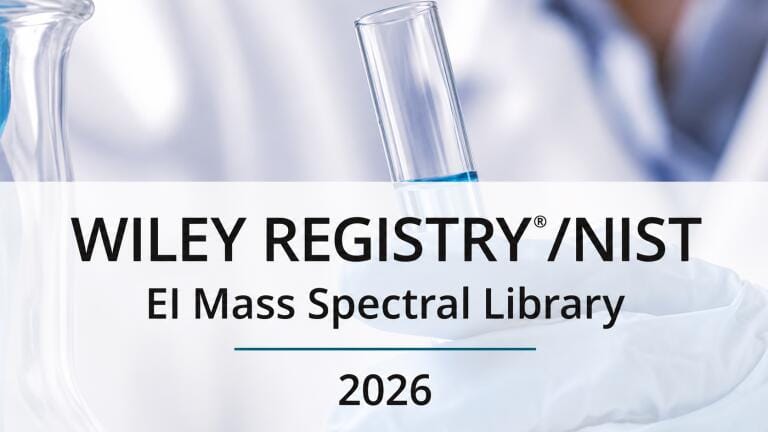
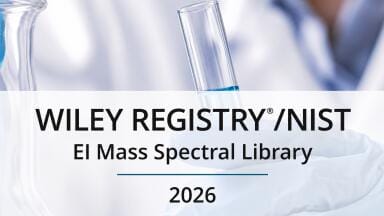
Wiley has released the 2026 edition of the Wiley Registry/NIST Mass Spectral Library, adding tens of thousands of validated compounds to a combined GC–MS reference database that now contains more than 1.2 million electron ionisation mass spectra
Wiley has released the 2026 edition of the Wiley Registry/NIST Mass Spectral Library, expanding a major reference resource used by laboratories to identify unknown chemical compounds through gas chromatography–mass spectrometry.
The updated database combines the Wiley Registry of Mass Spectral Data with the NIST/EPA/NIH Electron Ionization Mass Spectral Library, produced by the US National Institute of Standards and Technology (NIST). The 2026 edition has added tens of thousands of recently validated compounds across the two collections and now contains more than 1.2 million electron ionisation (EI) mass spectra.
Electron ionisation mass spectra provide characteristic patterns that can act as chemical fingerprints for individual compounds. In gas chromatography–mass spectrometry (GC–MS), compounds within a sample are first separated by gas chromatography before they enter the mass spectrometer. Electron ionisation then fragments the molecules in characteristic ways and the resulting mass spectrum can be compared with spectra from known compounds held within a reference library.
The quality and breadth of the reference database are therefore central to the identification process. A close match between an experimental spectrum and a validated reference spectrum can provide strong evidence for the identity of an unknown substance, although analysts must also consider factors such as chromatographic retention behaviour, sample composition and the quality of the acquired spectrum.
Laboratories have long used the Wiley Registry of Mass Spectral Data and the NIST/EPA/NIH Electron Ionization Mass Spectral Library as major reference sources for GC–MS analysis. Their combination within a single resource is intended to give analysts access to the depth of both collections without the need to consult separate databases.
“When a scientist runs a sample through a mass spectrometer, the results are only as good as the reference data behind them,” said Dr. Armughan Rafat, Wiley senior vice-president and chief artificial intelligence and data analytics officer.
“By uniting the Wiley Registry and the NIST Library in a single resource, we deliver the breadth, quality and validation scientists need to identify unknown compounds faster and with confidence,” he said.
The expanded collection forms part of Wiley’s portfolio of scientific data and research intelligence resources, which includes spectral databases, chemistry and materials literature and analytical tools intended to support research from initial discovery through to applied scientific work.
Mass spectral libraries have become particularly important in fields in which analysts must identify compounds in complex samples or establish the presence of substances with a high degree of confidence. Applications include pharmaceutical analysis, environmental monitoring, forensic science, toxicology, chemical manufacturing and academic research.
In environmental laboratories, for example, GC–MS can help to identify pollutants, pesticides, industrial chemicals and other contaminants within air, water or soil samples. Forensic laboratories can use the technique to examine seized drugs, toxicological samples, fire debris and other evidential material, while pharmaceutical laboratories use mass spectrometry for tasks that include impurity identification, quality control and the characterisation of chemical substances.
The value of a spectral library depends not only on the number of spectra it contains but also on the quality of the underlying reference measurements and the reliability of their associated chemical information. Expansion of a curated collection can increase the probability that an analyst will find a useful match when an unfamiliar compound appears within a sample.
Wiley said its spectral database resources are used by pharmaceutical, environmental and forensic laboratories worldwide. The 2026 edition of the combined library is available in formats compatible with commonly used analytical instrument systems, which allows laboratories to incorporate the reference data into established GC–MS workflows.
Spectral databases are not limited to mass spectrometry. Similar reference collections support several analytical techniques, including infrared (IR) spectroscopy, nuclear magnetic resonance (NMR) spectroscopy and Raman spectroscopy. Each technique records characteristic information about molecular structure or behaviour and researchers can compare experimental data with validated reference spectra to help establish the identity of an unknown material.
In mass spectrometry, the reference spectrum records the distribution and relative abundance of ions produced from a compound under defined analytical conditions. Electron ionisation is particularly suitable for library-based identification because its fragmentation patterns are highly reproducible when instruments operate under comparable conditions. This reproducibility has helped to make EI spectral matching a longstanding component of GC–MS analysis.
Wiley said the expanded Wiley Registry/NIST Mass Spectral Library was intended to provide laboratories with a broader validated reference base for compound identification and to support scientists who need to make analytical decisions from complex or unfamiliar samples.
ILM 51.6 Sept 2026




 Product directory























.jpg)