

Research news
Bolstering SORLA protein has potential as a therapeutic strategy for Alzheimer’s disease and other tauopathies
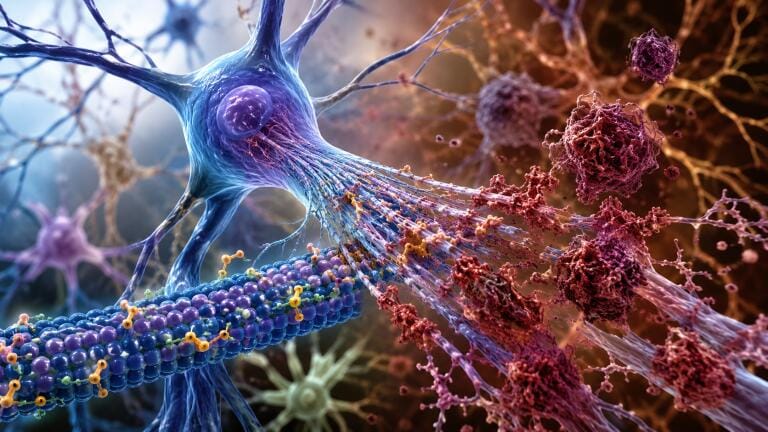
Alzheimer’s disease and several other forms of neurodegeneration share a common culprit. In these conditions, tau proteins that normally stabilise the microtubule filaments within neurons instead form toxic tangles, disrupting the circuits they otherwise have maintained.
Scientists at Sanford Burnham Prebys, La Jolla, California, USA, have reported findings showing that a different protein offers protection against the effects of these tangles. The results suggest that future research could yield novel treatments capable of boosting this protein’s ability to defend the brain.
Under normal conditions, tau proteins require no such safeguarding. They occur throughout the brain and central nervous system, where they help maintain the shape and structure of neuronal wiring. In Alzheimer’s disease and other conditions, however, tau proteins clump together inside nerve cells, forming what are known as tau tangles. These have been linked to cognitive impairment and nerve cell death in a group of diseases known as ‘tauopathies’.
The study focused on the protective capabilities of a protein called sortilin-related receptor with LDLR class A repeats (SORLA).
“In the last 15 or 20 years, considerable data has come out from our lab and other groups showing that SORLA can suppress one of the hallmarks of Alzheimer’s disease, amyloid-beta generation and accumulation,” said Dr. Timothy Huang, assistant professor in the Center for Neurologic Diseases at Sanford Burnham Prebys.
“Very little was known, however, about whether SORLA affected the tau tangles reflected on the other side of the coin in Alzheimer’s disease,” he said.
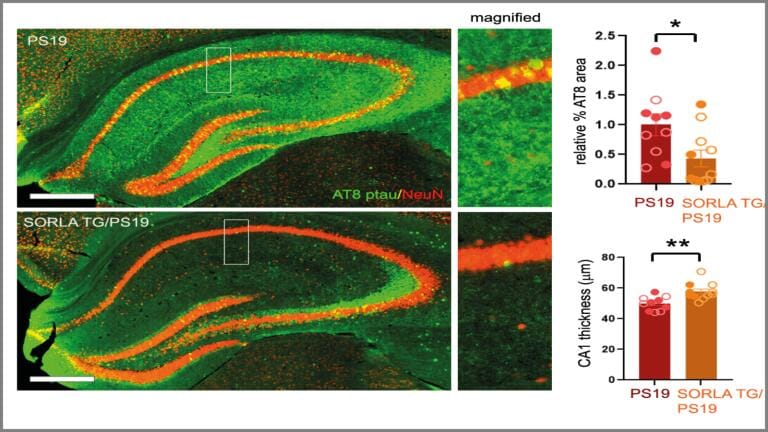
The research team began by crossbreeding mice engineered to produce extra human SORLA protein with mice that develop tau tangles, brain atrophy and cognitive deficits. This mouse model has enabled experiments to determine SORLA’s effects on tau protein build-up and its resulting harms.
An overabundance of SORLA protected against a number of biological processes linked to the formation of tau tangles and the progression of neurodegeneration. These included a reduction in hyperphosphorylation, the addition of too many phosphate groups to tau, and a reduction in the ability of misshapen tau to act as a ‘seed’ that catches with more tau to form clumps. This protective effect also extended to the preservation of synapses, the junctions between neurons, and to synaptic plasticity – the brain’s ability to adjust these connection points.
“When you upregulate SORLA, you can suppress the negative effects found in tauopathies,” said Dr. Huijie Huang, a researcher in the Huang lab at Sanford Burnham Prebys and lead and corresponding author of the study.
“We found there was less brain atrophy and less tau accumulation, which was very exciting to see,” she said.
Because some people carry mutations that disable SORL1 – the gene which encodes SORLA – the researchers also wanted to compare the effects of having extra SORLA with having none at all. Tests in mouse models genetically modified to lack SORL1 told a very different story.
“The opposite turned out to be true when we deleted the ability to produce SORLA proteins. A lack of SORLA exacerbated the harmful effects observed in tauopathies,” she added.
To determine how extra SORLA – or the lack of it – was either ameliorating or aggravating to tau-related disease, the research team combined sequencing techniques that capture protein and gene expression levels in individual cells with methods for mapping the spatial relationship of RNA and proteins within brain tissue.
The scientists found that upregulated SORLA prevented problematic changes in protein production at the synapses between neurons while also suppressing other drivers of tauopathy progression. Extra SORLA also dampened disease-related gene expression patterns in glial cells, the cells that support and protect neurons in the brain.
“One particularly notable finding that we can build on is the upregulation of a member of the plexin-B family of receptors in the absence of SORLA,” said Timothy Huang.
“There are unique drugs that can target this class of receptors that we may be able to apply to tau-related dementia disorders.
“One potential future direction is to repurpose these drugs to target overactivation of glial cells, and perhaps to reverse some of the phenotypes seen in tauopathies,” he explained.
The researchers also want to understand what happens within each individual cell type when SORLA is upregulated or downregulated. They plan to graft human neurons or glial cells into the mouse brain to study the effects of different SORLA mutations.
“Mouse cells and human cells are different. Because we’re looking at human disease, it’s more informative if we can observe the modulation and dysfunction of SORLA in the context of a human cell inside a diseased brain environment,” Timothy Huang concluded.
Further research should reveal more about SORLA’s ability to safeguard against the toxic effects of tau tangles and how therapies might be developed or repurposed to benefit patients with Alzheimer’s and other tau-related dementia disease.
For further reading please visit: 10.1126/sciadv.aed6825
ILM 51.6 Sept 2026



 Product directory



















,-photo-Karin-Allander.jpg)








.jpg)
