Research news
Researchers from the universities of Cologne and Wageningen have shown that some E. coli strains survive beta-lactam antibiotics because dying cells release an enzyme that protects the wider population
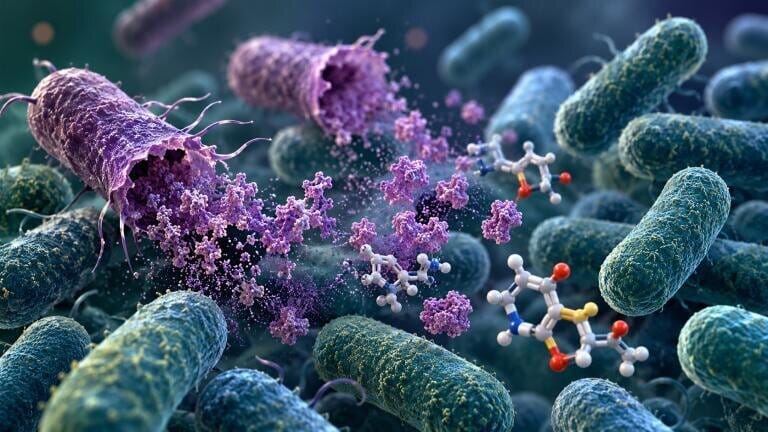
Bacteria can defend themselves against antibiotics with the help of an enzyme released by dying cells. That is the conclusion of a research group drawn from the Institute for Biological Physics at the University of Cologne, Germany and Wageningen University & Research, in the Netherlands.
The study was funded by the German Research Foundation as part of the Collaborative Research Centre 1310 which is formally known as ‘Predictability in Evolution’ and is a large, long-term, interdisciplinary research consortium.
The team, led by Professor Dr Joachim Krug in Cologne and Professor Dr Arjan de Visser in Wageningen, has demonstrated that Escherichia coli (E. coli) bacteria are able to produce an enzyme that chemically breaks down the antibiotic and renders it ineffective. Because this enzyme is released in particular by dying bacteria, the researchers have described this process as ‘altruistic cell death’. Individual cells are sacrificed to ensure the survival of the population as a whole. The findings help to explain the collective survival mechanisms of bacteria and could help researchers to improve the effectiveness of both existing and future antibiotics.
The project followed a discovery by the study’s first author, Dr Rotem Gross of the University of Cologne, who found that bacterial cultures, although they initially die off when exposed to the antibiotic, eventually recover and continue to grow unhindered. To investigate this recovery, the team examined two strains of E. coli, pathogens responsible for urinary tract infections, septicaemia and hospital-acquired infections, and their responses to beta-lactams, which are the most widely used class of antibiotics worldwide and include penicillins and cephalosporins.
The bacteria were found to produce an enzyme called beta-lactamase which chemically degrades the antibiotic. Once its concentration had fallen below a threshold level as a result of this enzymatic activity, the bacterial cultures can begin to recover.
“Therefore, the death of some of the bacteria contributes significantly to the long-term survival of the population as a whole which can be interpreted as an example of altruistic collective behaviour,” said Krug.
Surviving bacteria also play a part in resisting the antibiotic. These cells produce the same enzyme which remains inside the cell and degrades any antibiotic that they have absorbed. The researchers observed this pattern in both of the E. coli strains studied, though they noted that the extent to which cell death contributes to the reduction of the antibiotic varies considerably between the two.
This difference suggests the strains will also respond differently to beta-lactamase inhibitors, substances designed to circumvent bacterial resistance mechanisms, since these inhibitors are effective only in the surrounding culture medium and cannot penetrate intact cells.
Yet a higher rate of altruistic cell death therefore appears to make a population more susceptible to these substances which are already used routinely to treat infections.
“We were amazed by the variety of defence mechanisms that the bacteria are able to mobilise even under simple laboratory conditions,” Krug added.
The researchers say this variety makes it a considerable challenge to predict how specific antibiotics will perform under realistic physiological conditions a question which the team hopes to address in future work.
For further reading please visit: 10.1073/pnas.2526410123
ILM 51.6 Sept 2026



 Product directory



















,-photo-Karin-Allander.jpg)








.jpg)
