Research news
Researchers used patient-derived ‘mini brains’ to identify the mechanism behind DHDDS-related disease and found that nicotinamide mononucleotide – a naturally occurring form of vitamin B3 – may help to slow progression
A naturally occurring form of vitamin B3 has shown promise as a potential treatment for a severe and extremely rare neurodegenerative condition caused by variants in the DHDDS gene.
Researchers from The Netherlands and the USA have reported that nicotinamide mononucleotide (NMN) appeared to slow disease progression in patient-derived laboratory models and in early patient experience. The findings have been presented at the annual conference of the European Society of Human Genetics, in Gothenburg, Sweden, June 2026.
DHDDS-related disease usually manifests in early childhood and can cause tremors, seizures, impaired coordination and learning difficulties. The condition has features that resemble Parkinson’s disease, particularly because of its effect on movement. Until recently, families affected by the disorder had been told that no treatment was available to slow its progression.
Dr Irena Muffels, a clinical genetics resident at Wilhelmina Children’s Hospital in Utrecht, The Netherlands, described how the research began after two parents contacted scientists at the Icahn School of Medicine at Mount Sinai in New York, USA, where she had previously worked in the Morava-Kozicz laboratory. Their two children had been diagnosed with DHDDS-related disease and the family had been advised that their main hope was to wait until researchers took an interest in the rare condition.
“But they didn’t want to wait. They didn’t want their children to become wheelchair-dependent and unable to take care of themselves due to their movement problems,” said Dr Muffels.
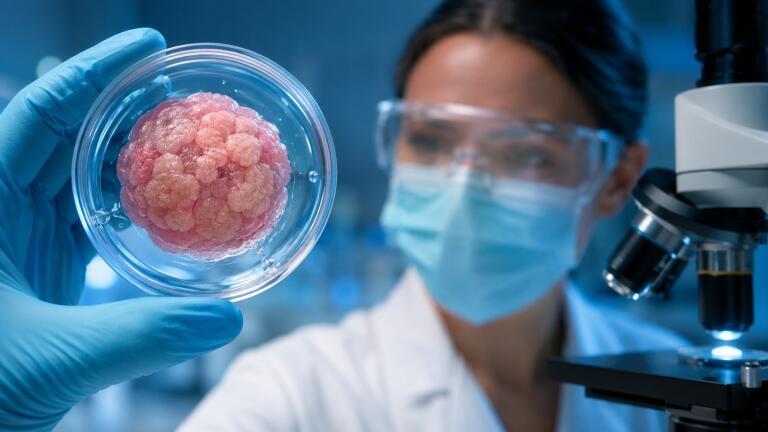
“So, they contacted Professor Eva Morava [and] we started to create mini brains – tiny blobs of brain tissue grown in the laboratory from patients’ own cells – thus avoiding the need to take samples directly from the children’s brains.”
The patient-derived mini brains enabled the researchers to study the mechanism of DHDDS-related disease and to examine why the condition progressed. After four months, the mini brains showed clear signs of deterioration, which reflected the damage seen in affected patients.
The DHDDS gene normally helps to produce dolichol, a small lipid ‘anchor’ that carries sugar. The researchers found that this anchor was severely reduced in the DHDDS mini brains. Sugar also helps to build glycans, which act like molecular antennae and help proteins to perform their correct functions. In the mini brain models, the team saw errors in the formation of these antennae.
The defective DHDDS gene also appeared to disrupt lipid metabolism more broadly. Reduced dolichol affected the handling of lipids and contributed to significant cholesterol accumulation in astrocytes which are brain cells involved in neuroprotection.
“This accumulation builds over time. This is why we think the disease progresses, since the accumulation of cholesterol leads to mitochondrial dysfunction, leading in turn to reduced energy production,” said Muffels.
The researchers worked with the biotechnology company Perlara to identify potential therapies by screening drugs approved by the US Food and Drug Administration, as well as vitamins. This process identified NMN as a candidate compound that could rescue a yeast model of DHDDS-related disease.
When the team tested NMN in the mini brains, it observed striking improvements. Because NMN is available to buy without prescription, some patients began to order it online before the laboratory experiments had been completed.
“Within a month we had noticed that these patients’ walking [had] improved and that they were more energetic, less shaky, and their movements became more fluid. It really seemed to slow down progression of the disease,” Muffels said.
NMN has previously been shown to improve molecular mechanisms in muscle cells from patients with mitochondrial disease, a serious paediatric metabolic disorder, and is currently being tested clinically in these patients. High doses of the vitamin have also been shown to slow progression and reduce symptom burden in patients with Parkinson’s disease.
“The word about NMN [was reaching] more DHDDS patients and we currently have 12 patients taking it. We recently received funding from CDG UK, a charity supporting those affected by congenital disorders of glycosylation, to start an international trial for NMN supplementation in DHDDS-related disease. Patients will take NMN for a year and will be evaluated every three months.” she said.
The trial has begun to enrol patients, although the researchers emphasised that further work would be needed to establish the safety, efficacy and appropriate dosing of NMN in DHDDS-related disease. The early findings nevertheless suggest that patient-derived brain organoids can offer a powerful route to study rare neurological conditions and to test treatments when conventional clinical research is difficult.
“This study is a perfect example of how rapid progress in genetic diagnosis can lead to novel treatments for rare diseases. Because rare diseases such as DHDDS affect so few people, it is usually very difficult to get industry interested.
“It is impressive that a united front of parents, charities and academics were able to find this promising therapy that is also cheap and widely available,” said Professor Alexandre Reymond, chair of the conference, who was not involved in the research.
*Mini-brain organoids are produced from human skin or blood cells and reprogramme them to become cells that can differentiate into any cell type (pluripotent stem cells), and then into neural stem cells. In the mini brains, different neurons are present, as well as support cells (astrocytes).
ILM 51.6 Sept 2026



 Product directory


















,-photo-Karin-Allander.jpg)




.jpg)
