Clinical, medical and diagnostics
Researchers at Osaka Metropolitan University have developed a laser-driven optical fibre platform that concentrated thousands of bacteria and microparticles into a single location within one minute, a capability that could support faster diagnosis of infectious disease and improve analytical sensitivity in low-volume liquid samples
A research at Osaka Metropolitan University (OMU), Japan, has developed a light-driven concentration technique that rapidly gathered bacteria and microscopic particles into a single confined region, a process that could improve the speed and sensitivity of disease detection and bioanalytical analysis.
The research focused on one of the central challenges in diagnostic microbiology and environmental analysis – how to detect extremely low concentrations of harmful biological material before disease progresses or contamination spreads. Certain pathogenic bacteria – including Escherichia coli O157 – can trigger severe illness even when present in very small numbers which means analytical systems must identify trace levels both quickly and accurately.
The team reported that its approach concentrated thousands to hundreds of thousands of bacteria or microparticles from a 20-microlitre liquid sample within just 60 seconds. According to the researchers, this represented more than a tenfold improvement in efficiency compared with conventional collection approaches.
Many existing bacterial detection techniques remain constrained by lengthy preparation stages or restricted collection efficiency. Traditional culture-based microbiology methods can require several days to cultivate detectable bacterial colonies under laboratory conditions. Faster immunological assays that rely on antibodies have reduced this timeframe substantially, yet these methods can still require several hours to produce reliable analytical results.
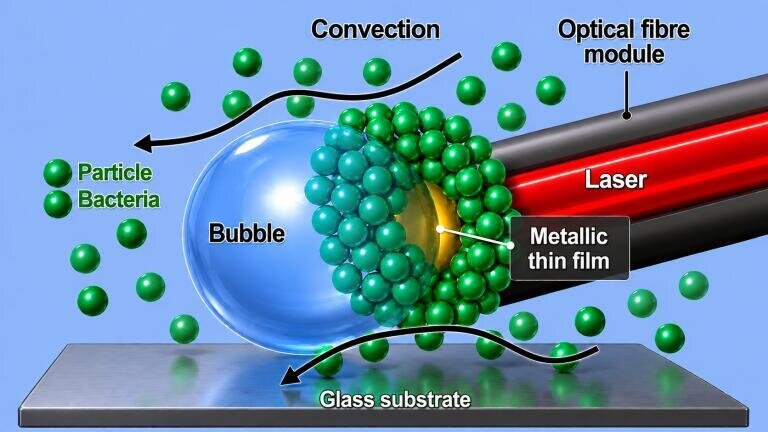
Seeking a rapid but sensitive alternative, the OMU team investigated whether light could serve as the basis for a concentration platform. The researchers designed a metallic thin-film-coated optical fibre that functioned as a highly localised photothermal source.
When laser light entered the optical fibre, the gold-coated tip absorbed the optical energy and converted it into heat. This highly confined heating process generated microscopic bubbles and induced fluid motion within the surrounding liquid sample. Together, these effects produced three-dimensional convection currents capable of transporting bacteria and suspended particles towards a concentrated collection region between the fibre tip and the bubble interface.
The researchers explained that this mechanism differed substantially from conventional photothermal collection systems, many of which operate primarily across two-dimensional surfaces or within narrow focal regions.
“Many conventional techniques are time consuming, require complex instrumentation, or are limited to collecting targets only near a surface or within a narrow focal region,” said Dr. Takuya Iida, professor at the Graduate School of Science and the Research Institute for Light-induced Acceleration System at OMU, and lead author of the study.
The researchers noted that the system’s ability to operate throughout the liquid volume represented a major technical distinction from previous photothermal concentration approaches. By creating convection currents that extended through three-dimensional space, the platform could collect targets from multiple directions simultaneously rather than only across a flat analytical surface.
“Unlike conventional photothermal techniques that primarily operate in two dimensions along a surface, this system captures targets from all directions within the liquid,” Iida said.
The study also highlighted the potential versatility of the approach beyond bacterial analysis alone. The researchers stated that the system could potentially concentrate nanoparticles and other micro- and nanoscale materials that contribute to immune responses or disease progression. Such capabilities could broaden the analytical utility of the technique across biomedical research, environmental science and diagnostic development.
Photothermal concentration technologies have attracted increasing interest in recent years because they can manipulate biological and chemical materials without the need for extensive mechanical systems. However, many earlier systems relied upon sophisticated optical instrumentation or complicated alignment procedures that limited practical implementation outside specialist laboratory environments.
The OMU researchers stated that their fibre-based platform reduced much of this complexity while maintaining high collection efficiency.
“Our results demonstrated that complex optical setups are not required to achieve high-efficiency concentration and that a compact fibre-based approach can substantially enhance collection performance in liquid environments,” Iida explained.
The researchers have now planned further work to integrate the concentration platform with downstream analytical technologies, including optical sensing systems and spectroscopic analysis methods. Such integration could enable direct identification and characterisation of concentrated biological material after collection.
The team also intends to evaluate the technology across a wider range of target particles, biological materials and environmental conditions to determine how broadly the system can operate across different analytical applications.
“Ultimately, we aim to develop a versatile and reliable approach for rapid, sensitive analysis in small-volume liquid samples, contributing to future advances in bioanalytical research, environmental monitoring, and related analytical technologies,” Iida concluded.
For further reading please visit: 10.1038/s42005-025-02480-9
ILM 51.6 Sept 2026



 Product directory

















.jpg)
