Research news
A chance observation made during unrelated brain research has identified a compound that could disrupt how viruses replicate and offer a novel route to broad‑spectrum antiviral treatment
An unexpected observation made by a researcher at the University of Queensland (UQ), Brisbane, Australia, could lead to a novel treatment for a range of deadly infectious diseases, including COVID‑19, pneumonia in infants and children, and viral infections caused by Ebola and hantavirus.
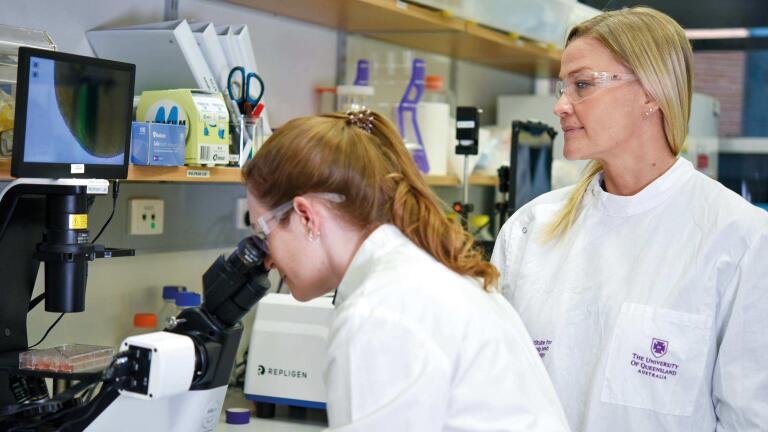
UQ neuroscientist and biochemist Dr Merja Joensuu said the idea emerged while she was working on an entirely unrelated research question.
“We were studying how certain processes work inside the human brain when I noticed a disruption in a pathway that numerous human viruses rely on to spread from one cell to the next,” said Dr. Joensuu, who is based at UQ’s Australian Institute for Bioengineering and Nanotechnology.
“That was the lightbulb moment – we realised that if we interfere with that pathway, we might be able to stop viruses from forming properly,” she said.
Alongside collaborator, Professor Giuseppe Balistreri of the University of Helsinki, Finland, Joensuu’s team then searched for a compound able to inhibit the pathway and identified one that is currently being trialled as a cancer treatment. The compound’s target is the human enzyme N‑myristoyltransferase 1, which helps direct where proteins are located and how they function within human cells. This process – as myristylation – is essential to the correct assembly of many viral particles.
“Viruses cannot reproduce on their own, so they hijack human cells to replicate,” said Balistreri.
“This drug disrupts how the cell functions, causing viral particles to be assembled incorrectly. The virus doesn’t know this and keeps making and releasing less‑effective versions of itself which would give the immune system time to clean up the infection,” he added.
In laboratory studies, the researchers tested the drug against a range of viruses in cell cultures, including COVID‑19, respiratory syncytial virus – a major cause of pneumonia in infants – and vesicular stomatitis virus, which causes disease in some livestock and occasionally humans.
The team found that infection levels dropped by around half after one day, and by up to 90 per cent after two days.
“The reduction is quite striking. The study also suggests this strategy could potentially work on viruses with high mortality rates and long incubation periods, like Ebola and hantavirus,” said Joensuu.
“All viruses rely on exploiting host cell processes to replicate and spread. Because we are interfering with the host cell instead of directly targeting the virus, there is less chance of it mutating and building resistance to the drug,” she said.
And given that the approach targets a host‑cell process rather than the virus itself, in principle the same strategy could be adapted to viruses beyond those already tested. It would confer an advantage over conventional antivirals which target viral proteins directly and can lose effectiveness as a virus mutates.
The researchers have emphasised that the drug is not yet approved for this use, and that further studies are needed to confirm its safety and effectiveness. But Joensuu said the approach had nonetheless shown considerable promise.
“You can imagine that this could be a very effective antiviral, for example in treating respiratory conditions, used in the form of a nasal spray or an inhaler,” she said.
For further reading please visit: 10.1038/s41467-026-72938-z
ILM 51.6 Sept 2026



 Product directory




















,-photo-Karin-Allander.jpg)






.jpg)
