Mass spectrometry & spectroscopy
Published over 11 years ago. See the latest and most current information on Mass spectrometry & spectroscopy.
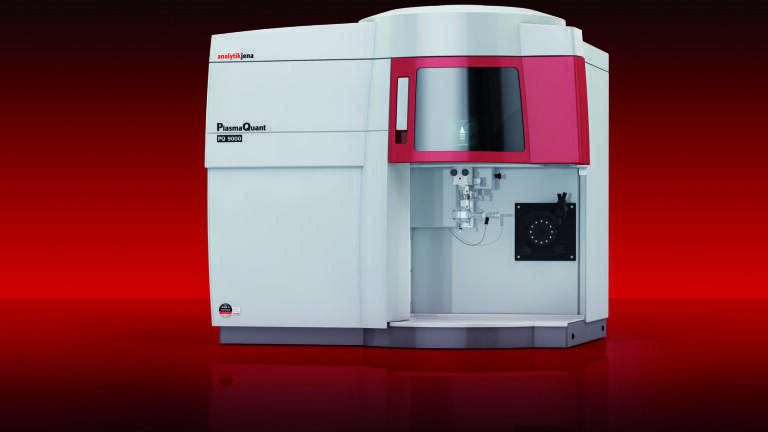
In today’s products and materials ultra-trace amounts of additives and impurities often have great influence on performance and grade. Rapid and reliable trace detection in ever more complex and concentrated analytical samples has thus become the key objective of many laboratories entrusted with product control and quality assurance. Since its introduction the stability of the inductively coupled plasma (ICP) has presented a major limitation for ICP optical emission spectrometry (OES), as the detection power is hugely affected by the ability of the plasma to tolerate high sample loadings such as of brine or naphtha. Here, effective detection limits will be best when excellent signal stability is achieved with minimal dilution as sample dilution limits the realm of possibilities in ultra-trace analysis. With the introduction of the High-Resolution Array ICP-OES PlasmaQuant ® PQ 9000, Analytik Jena brings a new generation of free-running high-frequency generators to the ICP-OES market that offer unmatched plasma performance for the continuous introduction of the highest matrix loadings with line intensity deviations smaller than 5% and RSD-values about 1% over an average working day.
ILM 51.6 Sept 2026





 Product directory