Mass spectrometry & spectroscopy
Published over 6 years ago. See the latest and most current information on Mass spectrometry & spectroscopy.
The Duetta two-in-one spectrometer is revolutionising fluorescence spectroscopy. It can be used as a fluorometer, as a UV-Vis-NIR spectrometer to measure absorbance, or as an instrument that measures true molecular fingerprints via the simultaneous acquisition of fluorescence and absorbance.
The fluorescence spectra are acquired in a single shot by a multichannel CCD detector without time-consuming wavelength-by-wavelength scanning. Thus, a full-range spectra can be generated in as little as 50 ms, more than 100x faster than typical fluorescence systems. This speed is a distinct advantage when collecting Excitation Emission Matrices (EEMs), i.e. multiple emission spectra at a range of excitation wavelengths. The CCD detector has the added advantage of a wider wavelength range than normally found on a bench-top instrument, extending 1,100 nm.
Not only does this two-in-one system enable two measurements to be made with one system (i.e. fluorescence and absorbance), its dual nature ensures reliable and correct data by automatically correcting for Inner Filter Effects (IFE). Without this, fluorescence data is prone to error.
Inner Filter Effects (IFEs) can significantly affect fluorescence emission spectral profiles, distorting their general shape, shifting the spectral position of the peak maxima and decreasing the emission intensities. Thus, when recorded with a standard spectrofluorometer, the detected fluorescence does not coincide with the true fluorescence emission of the sample, even for small fluorophore concentrations. These fluorescence spectra distortions can be critical in display, lighting and bioimaging applications where reliability and a precise knowledge of the emission properties are required.
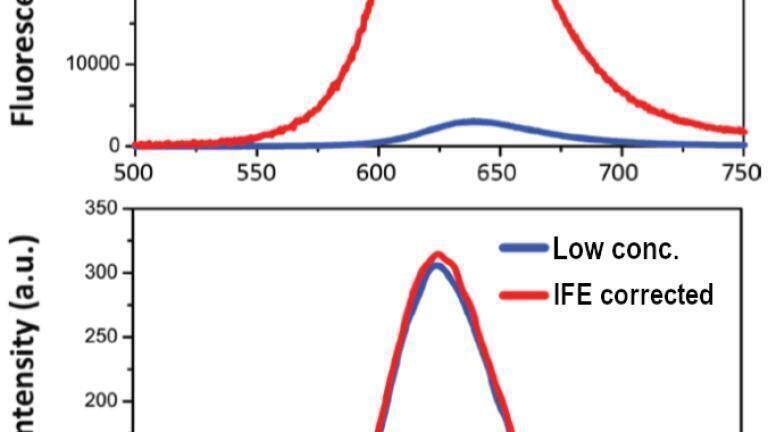
A study made with Indium Phosphide (InP) Quantum Dots (QDs) illustrates the importance of IFE correction. QDs absorb over a broad range and have photoluminescence emission over a narrow range which can be tuned depending on the material from which the QD is made and the size of the QD. The applications of QDs continue to expand, i.e. in vivo imaging, light-emitting devices, photodetection or solar energy conversion
Two suspensions of the same QD were prepared, once with an absorbance of 0.015 OD at 586nm, the other with 1.22 OD.
The emission spectra with and without IFE correction are shown in the figure. The high concentration spectrum is affected by significant and predictable distortions caused by concentration-dependent IFE – peak intensity is much lower than the concentration would suggest, and there is also a 15 nm wavelength shift of the maximum peak.
Such perturbations are observed with all spectrofluorometers. The Duetta, however, with its dual fluorescence and absorbance is able to measure true molecular fingerprints, correcting for IFE in real time…all in the blink of the eye.
More information online
ILM 51.6 Sept 2026



 Product directory


.jpg)
.jpg)





















.jpg)
