News
Published over 8 years ago. See the latest and most current information on News.
A new technology that could bring the gamma-ray laser out of science fiction and into reality is poised for testing by a team of scientists at University College London and the University of Surrey.
Funded by STFC, the UK researchers have combined their advanced atomic and nuclear physics expertise to conceive a proposal, arguably the first of its kind, which is achievable with current technology.
The proposal* involves caesium and an ultra-cold gas, called a Bose-Einstein condensate (BEC). The team’s idea is to make a BEC of caesium isomers (i.e. excited atomic nuclei), cooling them to 100 nano-kelvin, or one ten-millionth of a degree above absolute zero. At such extreme low temperatures, the atoms start to behave in remarkable ways - a gas of excited atoms can start to act like one single giant atom and the nuclei inside those atoms can effectively communicate with one another. In this state, they can also decay in unison, emitting their energy simultaneously - producing a powerful burst of coherent gamma radiation. This is the first time that a BEC of a radioactive species is proposed and in particular in their long-lived excited state, which will be produced by a particle accelerator.
Professor Phil Walker, Professor of Physics at the University of Surrey, said: “It is thanks to recent advances in our ability to make ultra-cold gases and also in our understanding about the way that nuclei in specific gasses can behave so uniquely, that we have been able to even consider that such an exciting and potentially game-changing experiment could be possible. We could be on our way to being one step closer to solving one of the most challenging problems in physics.”
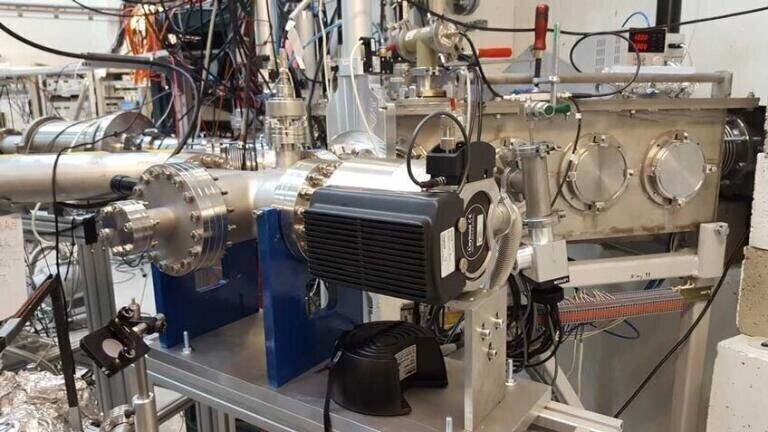
This research is no longer just theory. UCL’s Professor of Physics, Professor Ferruccio Renzoni, and his team are now busy setting up an experiment at the University of Jyväskylä Accelerator Laboratory in Finland. Key components, assembled at UCL, are already in place in Finland at the experimental facility. There, a cyclotron particle accelerator will produce the unstable caesium, and the UCL’s laser system will trap and cool it o 100 nano-kelvin, with a view to successfully producing the world’s first coherent gamma-ray emissions.
Professor Ferruccio Renzoni said: “If the project goes as planned, our experiment in Finland will show that it is possible to produce coherent gamma radiation in this way and will lead on to further tests that will confirm the best conditions for scaling up to make a practical device, the gamma-ray laser, over the coming years. In the meantime, several milestones in atomic physics and new insights in nuclear behaviour will be available for us to study.”
*[1] Coherent gamma photon generation in a Bose-Einstein condensate of 135mCs, L. Marmugi, P.M. Walker and F. Renzoni, Phys. Lett. B777 (2018) 281
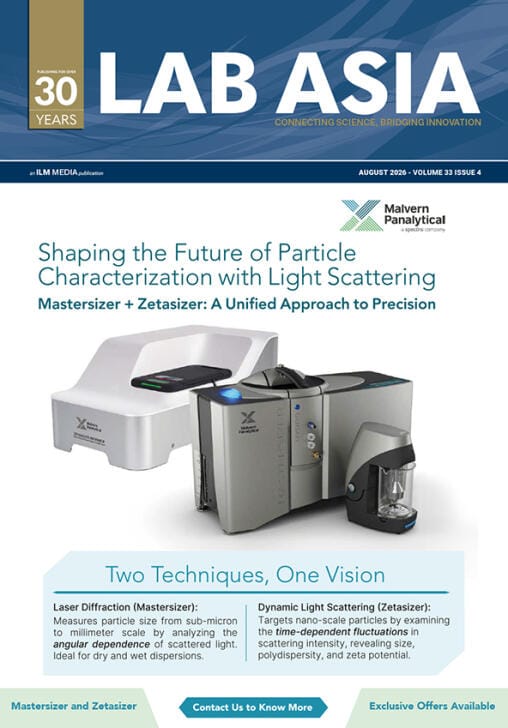
Lab Asia 33.4 - August 2026

 Product directory












.jpg)
.jpg)
.jpg)