News
Published over 11 years ago. See the latest and most current information on News.
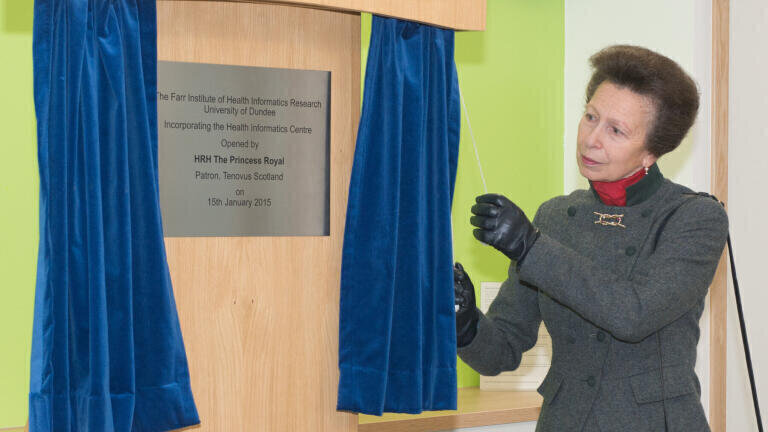
The Farr Institute of Health Informatics Research at the University of Dundee which has an international reputation for pioneering research in this field, was formally opened by HRH The Princess Royal on January 15th.
Use of health related data which is routinely collected by the NHS, along with associated collections of biological samples, provides a very powerful tool for medical research that allows important advances in health care to be made. To support this type of research a secure environment for data collection, cleaning, and curation is essential, in order that the public can be assured that key personal information is safe, and cannot be exploited inappropriately
The University of Dundee facilitated the development of the Farr Institute, a UK-wide collaboration that has been supported by the Medical Research Council and other funders to provide a linked network of ‘safe havens’ to allow appropriate use of health information and related data to be developed.
“We are delighted that HRH the Princess Royal has joined us today to open the Farr Institute and also to recognise the tremendous work done by Tenovus as a charity supporting valuable medical research across Scotland,” said Professor John Connell, Vice-Principal for Research at the University and Head of the College of Medicine, Dentistry and Nursing.
“The University has been a pioneer in the use of electronic health records to support medical research in the UK, working closely with NHS Tayside and Tenovus. It is a partnership that I think could only have happened here and has produced remarkable results. An initial grant from Tenovus of a few thousand pounds over 20 years ago has grown into this facility we see in Dundee today and a £30million eHealth network across the UK.”
Tenovus Tayside has supported research that uses carefully collected clinical data for a number of years, and sponsored projects have made important advances in the care of patients with Diabetes, Respiratory Diseases and Cardiovascular Disease.
Lab Asia 33.4 - August 2026

.jpg)

 Product directory













,-photo-Karin-Allander.jpg)








.jpg)