News
Published over 7 years ago. See the latest and most current information on News.
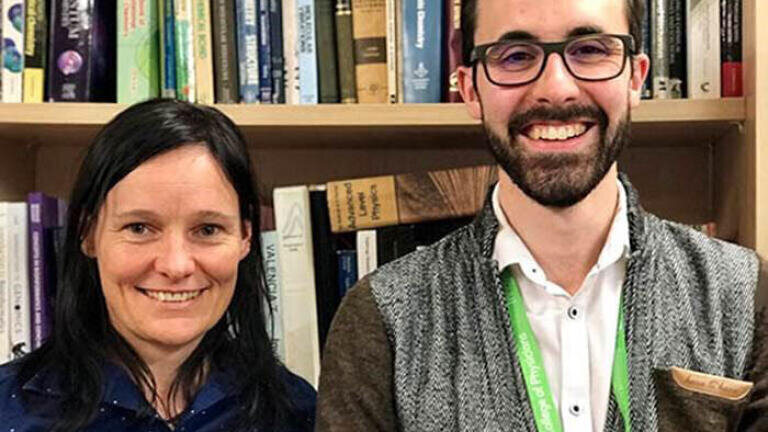
A collaboration of researchers from the UK, co-led by Dr Philippe Wilson from De Montfort University Leicester (DMU) and Professor Mel Mather, University of Nottingham, has been funded £100,000 to drive forward earlier detection of breast cancer. The consortium aims to develop and improve sensor technologies for liquid biopsy - using molecular markers in blood or other bodily fluids to detect disease.
A tiny diamond is at the heart of the technology which would also allow for non-invasive tests for patients.
Dr Wilson, VC2020 Lecturer in Biological Chemistry and Cheminformatics, said: "One of the most common diagnostic tests in medicine is MRI scanning, which looks at the way water will behave differently in diseased compared with healthy tissue. We're using similar principles but looking one step down at the composition of urine, saliva, blood and nipple aspirate fluid.
“The real innovation is that we can use an electron trapped in the defect of a microscopic diamond and read out its spin properties using light. So urine from a patient with cancer will produce a different signal to a sample from a healthy person.
"The advantage is it is miniature, low cost, we can do it at patient's side or even without the patient and it's non-invasive."
The leadership team also includes Professor Mangesh Thorat, from Queen Mary University of London and DMU's Professor Martin Grootveld. Professor Jacqui Shaw, University of Leicester and Dr Victoria James, University of Nottingham, are collaborators.
Funding was provided by Cancer Research UK, the Engineering and Physical Sciences Research Council and the Science and Technology Facilities Council.
ILM 51.6 Sept 2026



 Product directory


.jpg)
.jpg)













-and-Ezio-Rosato.jpg)