Liquid handling
Across all industries, pumps are often selected primarily considering pressure and flowrate requirements. For liquid chromatography applications, however, the stability of the flow has a significant impact on the performance and operation of the column, and so upstream supporting equipment, like pumps, pulsation dampeners, and mixers are specified not only according to pressure and flowrate requirements, but also to maximise flow stability.
Many flow delivery systems produce flow rates and pressures that fluctuate periodically which is referred to as ‘pulsation’. These include reciprocating pumps like piston pumps and diaphragm pumps.
In chromatography systems, pulsations in mobile phase delivery cause the flow and pressure within the column at any given time to deviate periodically from that which the column was designed for. This can have a negative impact on separation.
In most chromatographic processes, a detector is used to identify and quantify the components that pass through the column. It allows for the formulation of a chromatogram and – in larger-scale production processes – feeds information to advanced process control systems.
Periodic changes in flow and pressure can be picked up by the detector, causing an unstable baseline and increased noise. [1] This can reduce the accuracy of results, leading to either unreliable data for analytical processes or a misinformed control system in large-scale continuous processes.
Cyclic pressure changes can also damage the system. Keeping the pressure within the column as consistent as possible reduces the stress that the packing material, detector and instrumentation are subject to over time, meaning the lifespan of the system can be maximised.
Pulsations also cause inconsistencies in retention times between runs, meaning the high level of reproducibility required for an accurate result is not achieved. [2]
The Height Equivalent to a Theoretical Plate (HETP), a measure of the efficiency of the column at different linear velocities, is also affected by pulsation. Design aims to minimise HETP so that the efficiency of column operation is maximised.
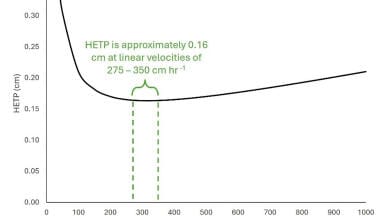
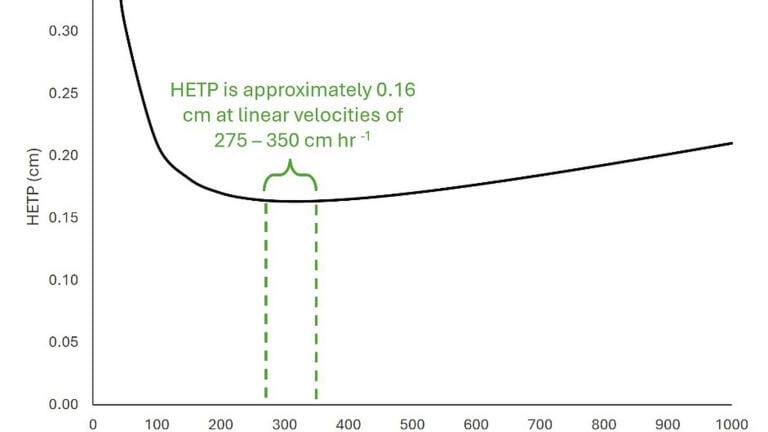
Plotting HETP against linear velocity forms a ‘Van Deemter Plot’, which will show the minimum possible value for HETP and determine an optimal velocity range for the column. An example of this is shown in green in Figure 1.
Figure 1 –
Example of a Van Deemter Plot to determine HETP
Let’s assume that the column represented in Figure 1 operates at process-scale and has a relatively large diameter of 10 cm compared to analytical systems and that the voidage is 0.5. Using the optimum linear velocity of 275-350 cm hr-1, obtained from Figure 1, the desired volumetric flowrate of the mobile phase is calculated at around 200 mL min-1.
Now, if the mobile phase is delivered by use of a single-cylinder piston pump with no pulsation dampening, a very large pulsation effect would be observed. Flow fluctuations could exceed 100 per cent of the average flow during compression phases and effectively stagnate during suction phases. An example of this pulsation is shown in Figure 2, in which the average flow is exactly 200 mL min-1 but severe fluctuations are observed.
Figure 2 – Severe flowrate pulsation: characteristic of a single reciprocating pump with no pulsation dampener
This translates to velocities exceeding 600 cm hr-1 and as low as zero occurring every pump cycle, assuming the desired flowrate is set as the average. These velocities would cause the HETP of the column to periodically move away from the minimum throughout operation. The column, therefore, would spend a lot of time operating at an efficiency that is much lower than the maximum, which could cause band broadening and reduce resolution. These effects, however, rarely occur in practice, as they can be sufficiently minimised through proper design/selection of an appropriate fluid delivery system.
Many methods exist to minimise the effects of pulsation with arguably the simplest and easiest method to implement is the pulsation dampener.
Most pulsation dampeners contain some compressible gas volume that is separated from the process liquid by a diaphragm. As the compression phase of the pump occurs, the gas is compressed and some liquid is stored in the dampener. During the suction phase of the pump, the compressed gas pushes the diaphragm which releases the stored liquid. An example of this mechanism is shown in Figure 3.
Figure 3 – Mechanism of a pulsation dampener
These units are relatively cheap to purchase and can be easily retrofitted onto existing flow delivery systems. However, the addition of this unit increases the volume of the system before the column – known as the dwell volume – which can lead to longer equilibration times, reducing throughput in some cases.
The addition of a unit after the pump also increases process complexity and the maintenance requirements of the system. So, despite the initial low costs of retrofitting the pulsation dampener compared to other methods, this must be balanced with the increased need for inspection and maintenance.
The use of dual-piston pumps is another method to significantly reduce pulsation. While they are less easily retrofitted to an existing system, they contribute less to the dwell volume. An example of how dual pump systems can be used out of sync to reduce pulsation is shown in Figure 4, which compares a dual system to that shown in Figure 2. Both systems have an average flow of 200 mL min-1.
Dual-piston pumps are the conventional method of flow delivery in most analytical HPLC and UHPLC applications and are available either as in-parallel or in-series. [3] Both offer reduced pulsation and a more precise flow delivery but are designed and operate slightly differently.
In-parallel systems use two pistons out of phase with each other on two separate flow paths within the pump system (Figure 5), while In-series systems use two pistons that act on the same flow path. For the latter, the movement of each piston with respect to the other is more complex than for in-parallel systems and often requires complex control systems. [3]
Figure 5 – In-parallel dual piston pump system
Figure 6 – In-series dual piston pump system
Both types of pumps are often used in conjunction with solvent mixing systems to deliver mobile phase liquid to chromatography columns in many different industries. The systems described are the go-to solvent delivery systems for most analytical HPLC and UHPLC columns; however, for modern larger-scale process-chromatography systems, some issues arise with this configuration. [3]
Processes at the industrial-scale use very high flowrates, where it becomes difficult for the conventional analytical or preparative configuration to meet specifications. At these scales, an alternative fluid delivery system is required that can meet the desired high throughputs while maintaining minimal pulsation.
One option is to still use a reciprocating piston pump, just with more pistons. Pumps with three, five, or seven pistons can achieve larger throughputs. However, at this scale, there are other issues that can hinder the performance of these pumps for use in chromatography.
The high throughputs and continuous operation of industrial processes – sometimes 24 hours a day – can cause equipment to wear. The packing and seals in piston-pumps are particularly susceptible to damage during continuous use and are widely known as one of the most common leak points in liquid chromatography systems. [4]
This is magnified if the mobile phase contains high concentrations of salts or buffers, often required to enhance separation. Micro-crystals can precipitate from these solutions onto the piston shaft, leading to rapid degradation of the seals. [5] This can be mitigated by active washing systems which will add to the initial costs of the pump but may save costs by reducing the maintenance requirement.
Large-scale pharmaceutical processes often use process chromatography systems to separate proteins, monoclonal antibodies, therapeutic polymers like polyethylene glycol and other important pharmaceutical products. These components can be easily damaged and are often extremely sensitive to shear forces.
Piston pumps produce high localised velocities which create enough shear forces to damage these fragile products. So, for the sample injection delivery system, or in processes where the sample may run through the mobile phase delivery system, piston pumps are rarely a suitable option if the sample contains shear sensitive products.
All the discussed issues have led many of those that use liquid chromatography for separation in industrial processes away from the conventional piston pump delivery systems and towards another option.
Diaphragm pumps have been employed across many industries in processes that require precise metering, sterility and handling of aggressive or harsh chemicals. The fluid path is completely separated from the mechanical components of the pump meaning chemical damage to the pump is minimised and the fluid is not contaminated by the pump itself.
Unlike piston pumps, diaphragm pumps have no mechanical seals, effectively eliminating one of the main reasons for leakage in liquid chromatography systems. The complete separation of liquid from the pump mechanical parts ensures sterility and means they can handle aggressive solvents and are not affected by the precipitation issue mentioned previously. Finally, they can also be designed to reduce the shear forces experienced by the fluid so that the delivery of proteins and other shear sensitive components is achievable.
Simplex diaphragm pumps are the simplest design and involve the use of a single diaphragm and two check valves to move fluid. As the diaphragm moves outwards, expanding the chamber volume, a vacuum is created which sucks liquid in. As it contracts, the liquid is pushed out. This is shown in Figure 7.
Figure 7 – Mechanism of a diaphragm pump
The issue with simplex designs for liquid chromatography is pulsation. As with the single piston pump example, the cyclic nature of the process causes inherent pulsation.
Duplex and triplex designs aim to mitigate the pulsation in the same way that dual-piston pumps would, by having the same pumping action multiple times out of sync, the pulsation effect can be reduced. This allows for a reduced pulse flow delivery system but with all the advantages of a diaphragm pump mentioned previously.
Some modern designs of diaphragm pumps use 3, 5, or even 7 diaphragms in a single pump head to offer extremely low pulsation. Internal valve design can also be optimised to minimise the shear forces produced by the pump. Pumps like this are increasingly being selected for liquid chromatography flow delivery systems at the industrial scale if harsh solvents, high buffer concentrations, low-shear or high throughputs are required.
From an industry perspective, the trend towards modern multi-diaphragm pumps for liquid chromatography applications is apparent. But does this mean the conventional methods for flow delivery, such as pulsation dampeners and piston pumps, are obsolete? Of course not. It means simply that, for larger-scale industrial applications, there is more to consider than for smaller-scale operations.
To conclude, minimising pulsation will always be a priority for liquid chromatography flow delivery systems. The methods for mitigating this, however, depend on the application. For analytical-scale operations that use normal solvents with low salt content, it is likely that the conventional dual piston-pump, mixer system, and pulsation dampener would suffice.
For processes at a larger-scale, or for those involving different chemicals and more sensitive products, it may be worth considering a multi-diaphragm pump as a method of flow delivery. It may be that a multi-diaphragm pump could be utilised alongside a pulsation dampener. Each individual chromatography system must be considered independently to determine the optimal flow delivery method.
ILM 51.6 Sept 2026


 Product directory