Laboratory products
As budgets tighten across research, clinical and biobanking environments, organizations face increasing pressure to reduce operating costs. Sample storage consumables are one area where lower-cost alternatives may appear attractive, particularly when products from different manufacturers look virtually identical.
However, visual similarity does not necessarily translate into equivalent performance. Subtle differences in manufacturing precision, mechanical reliability and material composition may only become apparent during repeated handling, transportation or prolonged storage. By then, the integrity of valuable, and sometimes irreplaceable, biological samples may already be compromised.
Published research has demonstrated that plastic labware can adsorb analytes, introduce chemical contaminants and affect downstream measurements. These findings reinforce the importance of evaluating storage consumables as an integral part of the sample management workflow, rather than selecting them on purchase price alone.
To investigate these risks, Azenta Life Sciences conducted an engineering-based comparison of its FluidX Tri-Coded storage tubes against commercially available alternatives across three commonly used working volumes: 0.5 mL, 1.0 mL and 1.9/2.0 mL.
The evaluation applied three established engineering principles: Form, Fit and Function. Together, these provide a framework for assessing dimensional consistency, mechanical performance, seal integrity and chemical purity.
The study compared seven commercially available storage tube types across three nominal capacities. FluidX Tri-Coded tubes served as the reference products, alongside four alternative products identified anonymously as Brands A - D. The letter designations are used consistently throughout the article and accompanying figures.
Tube Product Nominal capacity
A FluidX Tri-Coded 0.5 mL
B Brand A 0.5 mL
C Brand B 0.5 mL
D FluidX Tri-Coded 1.0 mL
E Brand C 1.0 mL
F FluidX Tri-Coded 1.9 mL
G Brand D 2.0 mL
Injection molding is commonly used to manufacture plastic sample storage tubes. The precision of this process is particularly important for products designed to interact with automated handling equipment and maintain secure seals throughout their working life.
Small variations in cap geometry, internal diameter or sealing surfaces may affect how consistently tubes engage with capping equipment. Manufacturing consistency is therefore an important consideration when qualifying storage consumables.
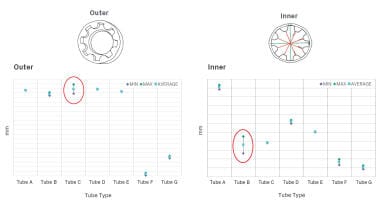
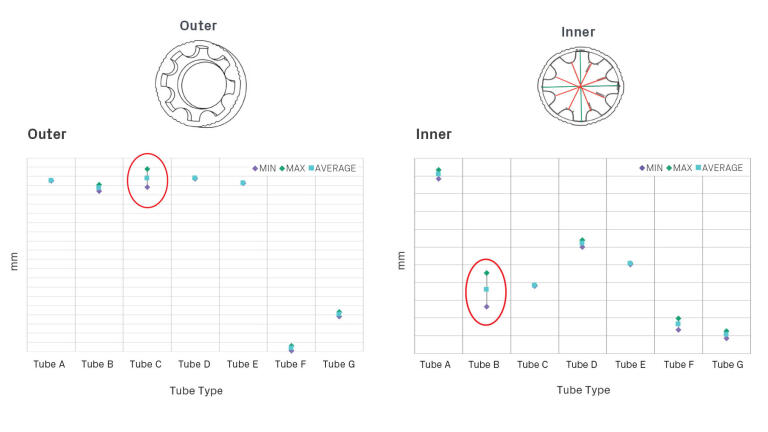
The study used digital microscopy to measure the maximum and minimum inner and outer diameters at cap engagement points across seven tube types, including Azenta FluidX tubes and other manufacturer’s tubes (see key). The difference between these measurements was calculated to assess dimensional consistency.
Most caps demonstrated minimal variation, averaging approximately 0.016 mm. However, two alternative products exhibited elevated variability: Tube B recorded an inner diameter variation of 0.094 mm, while Tube C recorded an outer diameter variation of 0.099 mm.
Although these measurements remained below the study’s 0.1 mm threshold, both approached a level associated with potential cap-to-driver engagement problems.
Such inconsistencies may become particularly relevant during automated capping and decapping, where repeatable mechanical engagement is essential.
The study also investigated variation between individual molding cavities of Azenta FluidX tubes and 96 format EXT caps to determine dimensional variability across tubes. Using a custom holding device and calibrated torque measurement, researchers assessed the torque required to fully engage caps manufactured from different cavities.
Monitoring over one year revealed only a very minor decline in torque performance, and measurements remained above the study’s acceptable threshold of 8 Ncm. This indicates consistent gap engagement and seal integrity in Azenta FluidX tubes and caps.
A separate assessment measured internal tube diameters at 16 cross-sections of tubes A-G (see key). Most tubes showed minimal variation, averaging approximately 0.024 mm. Tube D exhibited greater variation at 0.107 mm, although all measurements were reported to remain within the applicable tolerance limits, and even with this variation, tube D outperformed other manufacturers in other tests.
These findings demonstrate why qualification should extend beyond a small number of apparently identical products. Evaluating individual molding cavities and monitoring performance over time can help identify manufacturing variation before it affects routine laboratory operations.
A storage tube must do more than accommodate the required sample volume. Its cap and thread system must provide a reliable seal throughout handling, transportation and storage, including repeated opening and closing.
To assess mechanical reliability, the study examined capping torque, thread durability, pressure resistance and seal performance following repeated freeze–thaw cycles.
Using a calibrated digital torque gauge, researchers measured the maximum torque required to fully engage caps. Tubes A-E were tested, and testing was repeated after five capping cycles to assess potential thread wear.
Controlled capping forces of 8 Ncm for 96-format tubes and 10 Ncm for 48-format tubes were used as the study’s reference conditions.
The results revealed considerable variation between products. Tubes B, C and D demonstrated significant tube-to-tube variability in maximum torque, while Tubes B and C failed to complete five cycles at the required 8 Ncm because of thread stripping.
For example, Tube A recorded a torque range of 8.5–9.9 Ncm, compared with 9.5–15.8 Ncm for Tube B and 5.1–10.4 Ncm for Tube C. These differences illustrate how products with similar external dimensions can exhibit markedly different mechanical characteristics.
Thread wear and inconsistent torque performance are particularly relevant to automated workflows, where equipment applies predefined capping forces. A tube that cannot reliably withstand the required torque may be unsuitable for the intended automated process.
Figure 2. Capping torque performance across seven storage tube types following repeated cap/decap cycles. Differences in torque consistency and thread durability highlight variations in mechanical performance between commercially available products.
Following five capping and decapping cycles, tubes A-G were subjected to pressure testing based on IATA shipping conditions. This included an air pressure test at 30 kPa for five minutes and a liquid pressure test at 95 kPa for 30 minutes.
Tube B exhibited measurable air leakage, while Tubes C and G showed leakage under pressure. Tube C also demonstrated inadequate thread performance, with only one of eight samples meeting the torque tolerance.
These results indicate that seal performance cannot be assumed from visual inspection or initial cap engagement alone.
Pressure testing provides an additional means of identifying potential leakage risks relevant to sample transportation and storage.
Figure 3. Measures the role internal pressures plays on each tube based on IATA validation protocols. Based on those protocols, measured how well the seal of the tube can withstand these pressures.
Cryogenic storage introduces additional demands on tube and cap systems. Changes in temperature and repeated handling may affect sealing performance, particularly where mechanical inconsistencies are already present.
To investigate these effects, tubes A-G were filled with their maximum working volume of 99.5% ethanol, capped to their designated torque and weighed. They were then subjected to five freeze–thaw cycles at −150°C, followed by pressure testing at 95 kPa for 30 minutes. Sample mass was recorded after each cycle.
The results revealed differences in sample retention. Tubes A, D and F demonstrated minimal to no leakage, while Tubes B, C, E and G exhibited sample loss averaging approximately 0.05 g, or 3.5%. Complete sample loss was observed in Tube C.
The findings highlight the importance of assessing storage tubes under conditions representative of their intended use. Initial sealing performance alone may not adequately predict reliability following repeated thermal and mechanical stress.
Mechanical integrity is only one aspect of long-term sample protection. The chemical composition of storage consumables must also be considered, particularly for applications involving sensitive downstream analytical techniques.
Plastic materials may contain additives, processing aids or residual compounds that can be extracted under certain conditions. The presence of these substances does not automatically establish sample contamination, but identifying their potential to interact with stored materials is an important part of labware qualification.
To characterize the chemical profiles of the tested products, samples in tubes A-G underwent ethanol extraction at 40°C and 120 rpm for seven days. The resulting extracts were analyzed using gas chromatography–mass spectrometry (GC-MS), with compounds identified through library-based comparison.
Most products contained additives identified as non-harmful within the scope of the study. However, Tubes B, C and E exhibited additional compounds, including hydrocarbons and substances associated with processing additives.
Tetracosane was detected in Tubes B, C and E, while benzene was reported in Tubes B and C. The analysis also identified phenolic derivatives and other compounds of potential concern.
These findings demonstrate that visually comparable storage consumables may have substantially different extractables profiles. The implications for sample quality will depend on the compounds involved, their concentrations, the storage conditions and the sensitivity of the intended downstream assays.
Library-based identification provides an initial screening approach; additional targeted analysis may be required to confirm compound identities and establish application-specific risks.
While accelerated testing provides valuable insight into potential failure modes, extended storage studies are also important for understanding performance over time.
Azenta conducted a separate long-term assessment of FluidX 1.0 mL 96-format and 1.9 mL 48-format tubes. Samples containing Ringer’s solution were stored at −80°C, periodically removed, thawed to room temperature, weighed and returned to storage over more than five years.
The average weight loss after five years was approximately 0.05% for the 96-format tubes, equivalent to 0.9 mg per tube, and 0.14% for the 48-format tubes, equivalent to 5.4 mg per tube. No cracking, crazing or other physical damage was observed.
These findings provide additional evidence of the tested reference products’ performance under prolonged storage conditions. However, long-term performance remains dependent on the specific tube design, sample type, handling practices and storage environment.
The comparative evaluation demonstrates that storage tubes with similar external appearances can differ substantially in dimensional consistency, mechanical durability, seal integrity and chemical composition.
Not every dimensional variation observed resulted in a performance failure. However, the study identified examples where thread wear, inadequate torque performance and leakage occurred under defined testing conditions. These findings reinforce the value of evaluating multiple performance characteristics rather than relying on a single qualification test.
For laboratories and biobanks, the consequences of unsuitable storage consumables can extend beyond the initial cost of replacement. Sample loss may require repeat collection or analysis, while inconsistent mechanical performance can interrupt automated workflows. Chemical extractables may also require additional investigation where sensitive analytical methods are involved.
A structured qualification process should therefore consider the complete sample lifecycle, from initial collection and processing through transportation, storage and eventual retrieval.
Selecting long-term storage labware requires consideration of more than price, capacity and apparent compatibility.
Dimensional consistency, mechanical reliability, seal integrity and chemical composition all contribute to a storage system’s suitability for its intended application. Engineering-based assessments of Form, Fit and Function provide a practical framework for identifying potential weaknesses and comparing commercially available products.
By applying appropriate qualification criteria and testing under representative operating conditions, laboratories can make more informed procurement decisions and reduce avoidable risks to sample integrity.
1. Zwart, S. R., et al. (2011). Effects of long-term sample storage on biomarker measurements. Clinica Chimica Acta.
2. Bowen, R., et al. (2012). Impact of blood collection tubes on proteomic biomarker measurements. Clinical Proteomics.
3. Caudill, J., et al. (2024). Container closure integrity testing at cryogenic temperatures. PDA Journal of Pharmaceutical Science and Technology.
4. Zimmermann, L., et al. (2019). Benchmarking the in vitro toxicity and chemical composition of plastic consumer products. Environmental Science & Technology.
5. Kofanova, O., et al. (2021). Pre-analytical considerations for biospecimen integrity: adsorption, leachables, and contaminants. Biopreservation and Biobanking.
6. Azenta Life Sciences. (2026). Long Term Storage Sample Tubes: Understanding Inherent Risks in Choosing Imitators. Full technical note.
LMUK 51.7 Nov 2026



 Product directory