Laboratory products
OHAUS Corporation is executing a strategic transition across its entire refrigerated centrifuge portfolio, migrating from the synthetic Hydrofluorocarbon (HFC) blend R452A to the natural hydrocarbon R290 (Propane).
This initiative is driven by a dual commitment to environmental sustainability, safety, and technical excellence.
While R452A possesses a high Global Warming Potential (GWP) of 2 140, R290 offers a nominal GWP of 0.02 (based on the latest IPCC (Intergovernmental Panel on Climate Change) reports).This transition achieves a 99.8% reduction in direct GWP impact and realizes significant gains in thermodynamic effciency, including a reduction in coolant charge volume by 66% to 82%*.
This paper details the environmental, regulatory, and performance-based rationale for this transition, ensuring OHAUS products remain at the forefront of laboratory innovation.
The primary catalyst for this transition is the drastic reduction of the Global Warming Potential (GWP) associated with laboratory cooling systems.
GWP is a relative measure of how much heat a greenhouse gas traps in the atmosphere.
Specifically, it compares the amount of heat trapped by one ton of a specific gas to the amount of heat trapped by one ton of carbon dioxide (CO2) over a 100-year period. Since CO2 is the baseline, its GWP is 1.
The switch from R452A to R290 represents a major advancement in the environmental strategy of OHAUS.
R452A: A synthetic HFC refrigerant blend with a GWP of 2 140. This means that releasing 1 kg of R452A into the atmosphere has the same warming impact as releasing 2 140 kg of CO2.
R290 (Propane): A natural hydrocarbon refrigerant with a GWP of 0.02 (based on IPCC AR6 - the Sixth Assessment Report by the Intergovernmental Panel on Climate Change). Assessment Report by the Intergovernmental Panel on Climate Change).
Beyond the chemical properties, R290’s superior efficiency allows the system to operate with much less fluid.
OHAUS has successfully reduced coolant filling volumes by 66% to 82%.
By using a significantly smaller amount of a much cleaner gas, the total “carbon risk” of the device - the potential damage caused if the gas were ever to leak - is virtually eliminated.
Unlike synthetic HFC blends like R452A, which contain fluorinated compounds, R290 is a fluorine-free natural refrigerant. This transition aligns with emerging global health and environmental standards, specifically the REACH (Registration, Evaluation, Authorization, and Restriction of Chemicals) regulations in Europe.
A major concern with synthetic refrigerants is their association with PFAS (Per- and Polyfluoroalkyl Substances), often called “forever chemicals”. When synthetic refrigerants eventually released in the atmosphere, they can degrade into Trifluoroacetic acid (TFA). TFA is highly mobile, does not degrade naturally, and accumulates in the global water cycle, potentially impacting soil and drinking water quality. By adopting R290, OHAUS ensures reduced PFAS impact due to the PFAS-free coolant, contributing to the prevention of long-term chemical pollution.
OHAUS engineering data confirms that the R290 system is not only comparable but superior in efficiency to previous synthetic systems.
The transition is not a compromise—it is a performance upgrade.
To understand why R290 is superior, one must understand the “Temperature Glide”.
R452A is a zeotropic blend, meaning it is a mixture of different gases (R32, R125, and R1234yf). Because these chemicals have different boiling points, they do not evaporate or condense at a single, constant temperature. Instead, they evaporate sequentially over a range of temperatures - this range is the “glide.”
In a centrifuge, this can lead to thermal stratification, where different parts of the cooling circuit are at slightly different temperatures, making it harder to maintain a perfectly uniform environment for your samples.
In contrast, R290 is a pure, Msingle-component fluid with Zero Glide.
Because R290 has a single, constant boiling point, the cooling provided is perfectly consistent across the evaporator coils. This is essential for protecting heat-sensitive biological samples where maintaining the specified temperature accuracy is critical for result integrity.
Faster Pull-down Times: R290 has higher thermal conductivity than HFC blends, allowing it to move heat away from the rotor chamber much faster. This results in reaching set temperatures more rapidly, reducing wait times between runs.
Energy Efficiency: The compressor does not have to work as hard to compensate for the “shifting” temperatures of a blend. This leads to lower energy consumption and reduced operational heat output into the lab environment.
Note: Internal measurements demonstrate a clear reduction in actual energy consumption, reflecting improved efficiency with a lower rate of energy transfer.
Safety is a paramount consideration for OHAUS. While R290 is classified as A3 (highly flammable), it is important to place this in the context of modern engineering.
R290 has been used safely for decades in domestic refrigerators and air conditioners. In an OHAUS centrifuge, the safety is “built-in” through several layers of protection:
Minimal Charge Size: Because R290 is so effcient, the amount used in a Frontier 5000 unit is extremely small - often less than the amount of butane in a few standard lighters. This volume is well below the safety thresholds for even small, enclosed laboratory spaces.
Hermetic Sealing: Every OHAUS R290 unit is factory-validated to meet the IEC 61010-2-020 international safety standard for laboratory centrifuges.
The refrigeration circuits are hermetically sealed, meaning they are air-tight and designed to prevent any gas from escaping.
Simplified Logistics: By keeping the R290 refrigerant charge below 100g, OHAUS Frontier 5000 Centrifuges stay well under the international 100g limit. This engineering advantage ensures seamless global transport by avoiding “Hazardous Goods” classifications, surcharges, and heavy administrative burdens.
The transition to R290 ensures that OHAUS products comply with the most stringent global environmental frameworks, future-proofing your lab against changing laws:
Regulation (EU) 2024/573 of the European Parliament and of the Council on fluorinated greenhouse gases: This regulation mandates a strict phase-down of fluorinated greenhouse gases. By switching to a natural refrigerant, OHAUS users are already compliant with future bans on HFCs.
United States Environmental Protection Agency (EPA) Significant New Alternatives Policy (SNAP) Program: OHAUS aligns with the Environmental Protection Agency’s program to identify and promote safer alternatives to ozone-depleting substances and high-GWP gases.
REACH and PFAS Restrictions: As discussed, R290 is a “natural” gas that avoids the upcoming regulatory hurdles facing fluorinated “forever chemicals.”
IEC 61010-2-020: Compliance with the primary safety standard for laboratory centrifuges globally.
Choosing OHAUS centrifuges with R290 significantly reduces the Total Cost of Ownership over the life of the instrument:
Reduced Energy Costs: The high thermodynamic efficiency of R290 translates directly into lower electricity bills. For labs running multiple units 24/7, these savings are substantial.
Exemption from Environmental Taxes: Many regions are implementing “carbon taxes” or “HFC quotas” that drive up the price of synthetic refrigerants. Natural refrigerants like R290 are exempt from these costs.
Longevity: Systems designed for R290 often run at lower pressures and more stable temperatures, reducing wear and tear on the compressor.
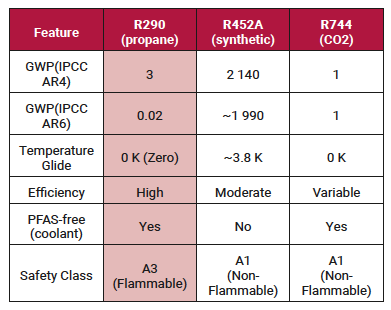
While current European and North American regulations often still refer to the IPCC Fourth Assessment Report (AR4), which gives R290 a GWP of 3, the scientific community has already moved forward. The Sixth Assessment Report (AR6) revised the GWP of R290 down to 0.02.
This trend shows that as measurement methods improve, the environmental “cost” of R290 continues to drop, while synthetic gases remain under scrutiny.
By adopting R290 now, OHAUS is not just meeting today’s standards - it is investing in a technology that will remain the “gold standard” for the next several decades.
You won’t need to replace your equipment because of a change in environmental law, OHAUS has already built for the future.
The table below summarizes why OHAUS selected R290 as the optimal balance for the laboratory environment:
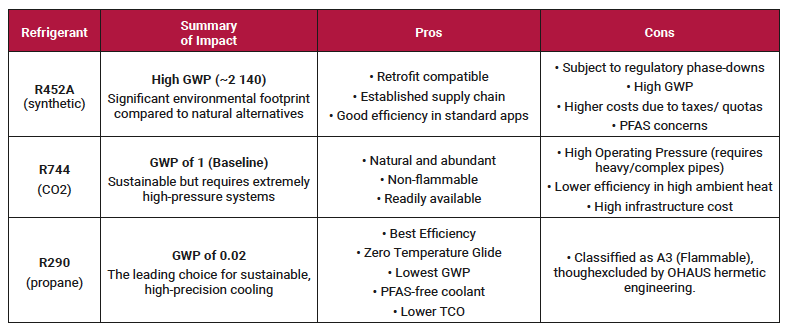
Conclusion of Comparison: While CO2 has a GWP of 1, its application in centrifuges is limited by the massive design challenges of high-pressure systems. R452A, while established, is an environmental liability.
R290 stands out as the superior choice, offering an almost 100% reduction in GWP compared to R452A without the design complexities of CO2.
The transition of the OHAUS centrifuge portfolio to R290 marks a significant milestone in sustainable laboratory practices.
Key takeaways:
Unrivaled Sustainability: An almost 100% reduction in GWP and a reduction in PFAS/TFA “forever chemical” risk through the use of natural coolants.
Safety Excellence: Fully compliant with IEC 61010-2-020, using factory-sealed, hermetic low-volume charges that prioritize laboratory safety.
Zero Glide Precision: Pure R290 ensures absolute mtemperature uniformity and mfaster cooling, protecting your most sensitive research.
Regulatory & Financial Security: Compliance with EU F-gas and US EPA SNAP standards ensures your equipment is protected from future bans and rising synthetic gas costs.
Responsible Manufacturing: The OHAUS Frontier 5000 series is produced in a facility certified mto ISO 14001 standards. This ensures that your research is supported by equipment manufactured under a rigorous Environmental Management System.
LMUK 51.7 Nov 2026



 Product directory